Time flies so fast. I started the 2nd year of my MFA program. It’s been like a jet coaster ride: running around, ups and downs with full speed.
There are many ”new” things happening this fall semester. 1) I am teaching two movement classes jazz and ballet for non-major students, 2) fully in-person classes, 3) living with one of my cohorts…. so many ”first time”!! It is exciting but exhausting at the same time.
My challenge for this semester is to ground myself and preparing for the fruits of this MFA journey. The starting of my 2nd year feels fresh like my 1st year since we are shifting to fully in-person class. COVID is still a thing however I definitely have a strong community that I can rely on and deeper creative thoughts.
In Japan, there is a quote from Zeami,
“初心忘るべからず。=Don’t forget your first resolution.Always keep your mind open and evolvIng.”
Zeami established Noh, which is the oldest traditional performing arts in Japan. He mentioned in his book saying obtain one art form takes a lifetime. As a movement practitioner, this word hits me hard. It tells me the importance of rooting myself and reminding where and why I started this journey with dance.
My hope this semester is to deepen my understanding of the relationship between me and dance. I have been dancing for almost 22 years yet there are many things I need to learn to expand. However, if I keep looking up and forget the root, I will lose my growth and eventually fall.
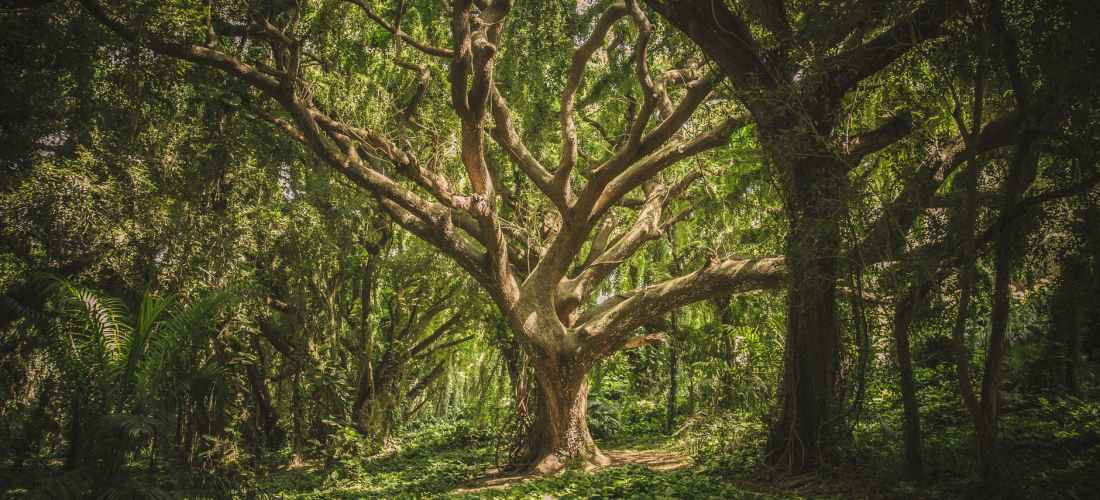
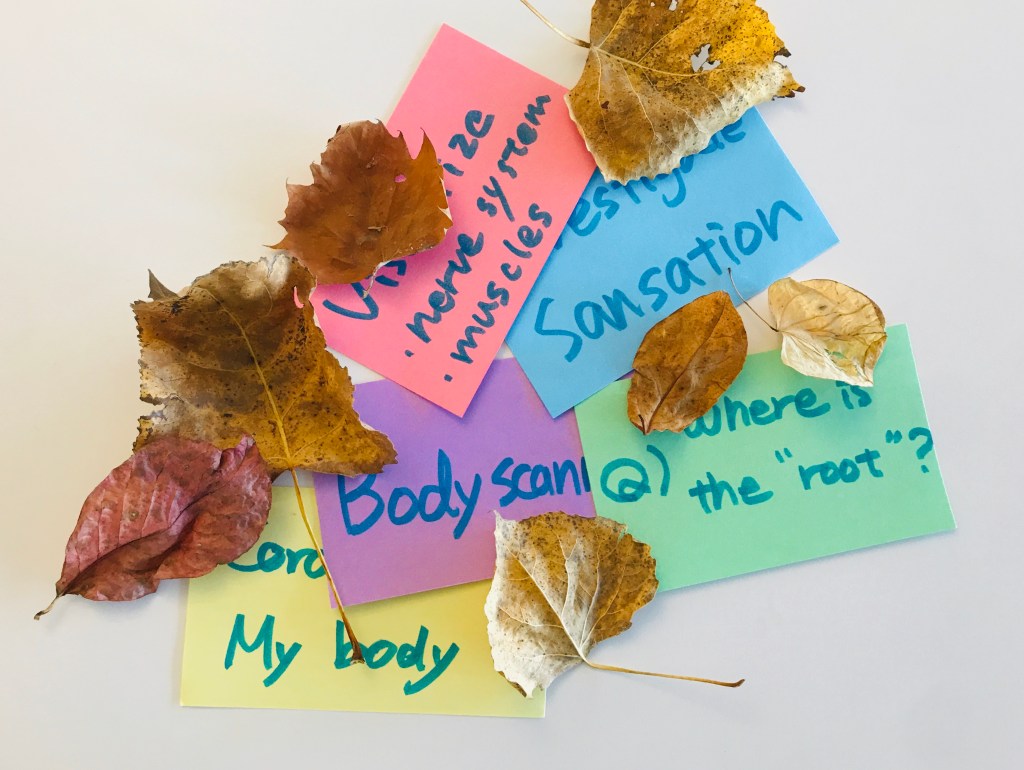
Reminder: Pause and look down where you arrive at. Finding the connection to the ground and feel the root/the heart where everything starts from.
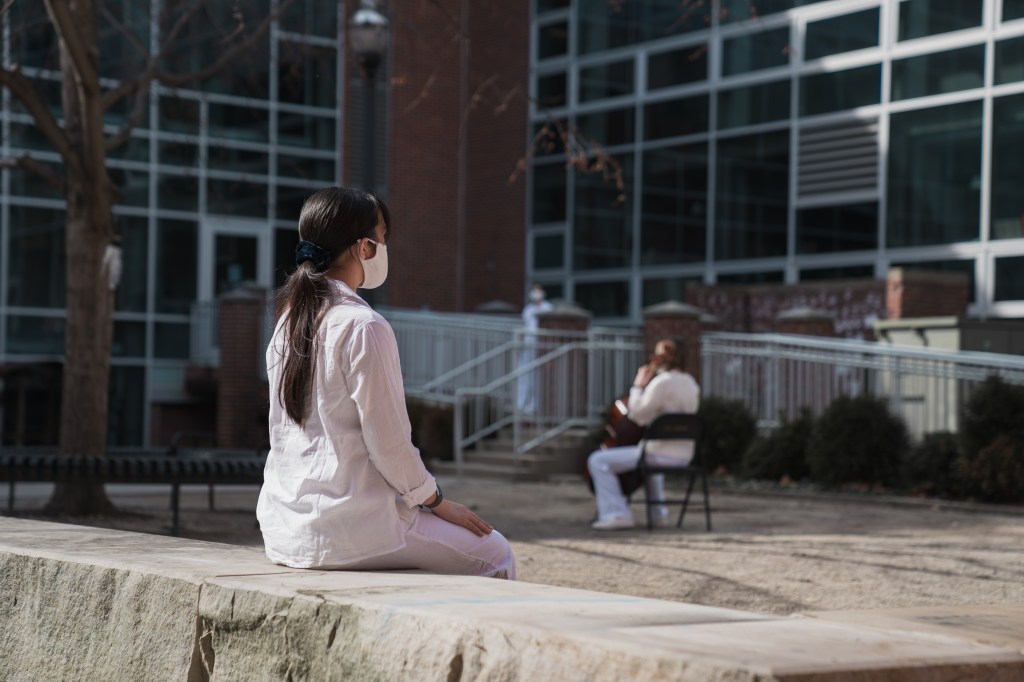
I had the privilege to be part of the thesis project with Laura Neese (3rd year MFA at OSU dance). I have been working with her since last fall, and this performance is an extension of her research.
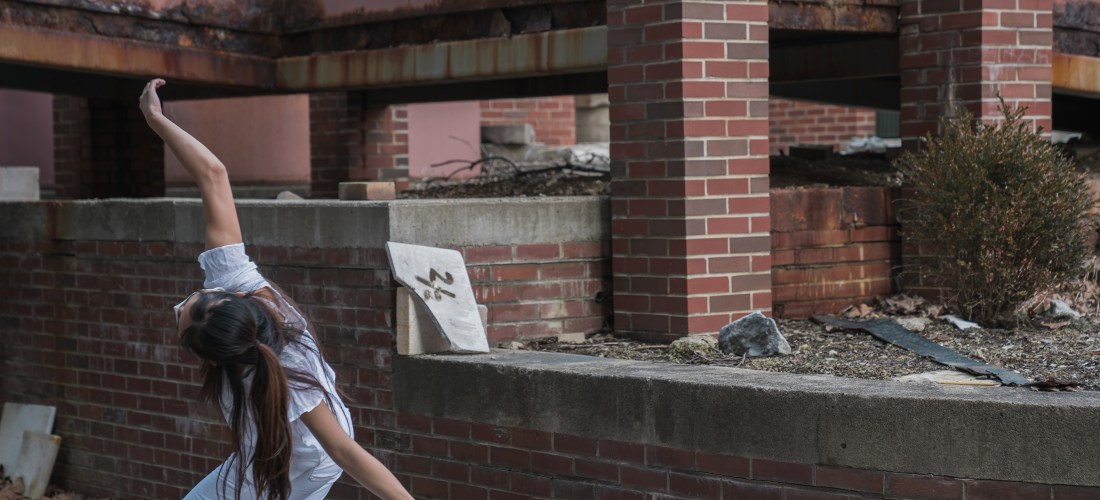
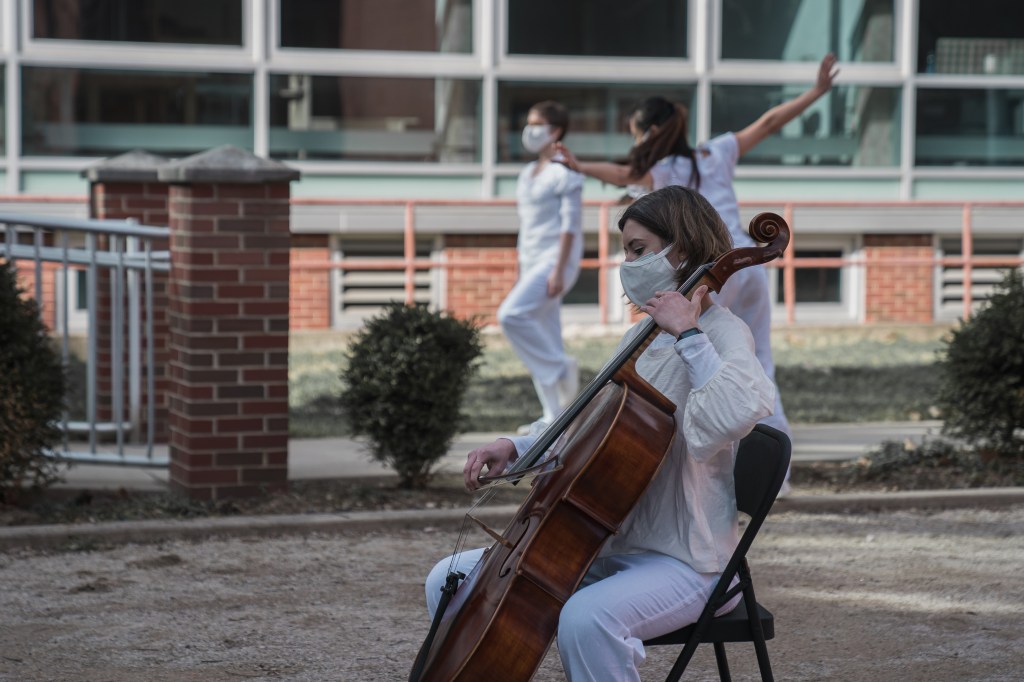
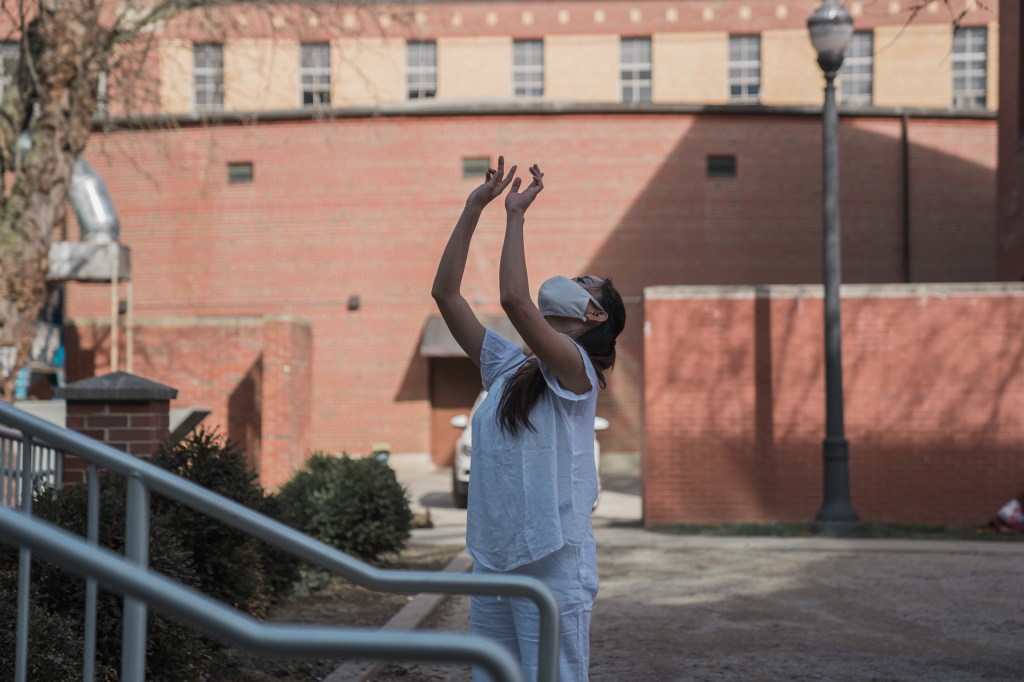
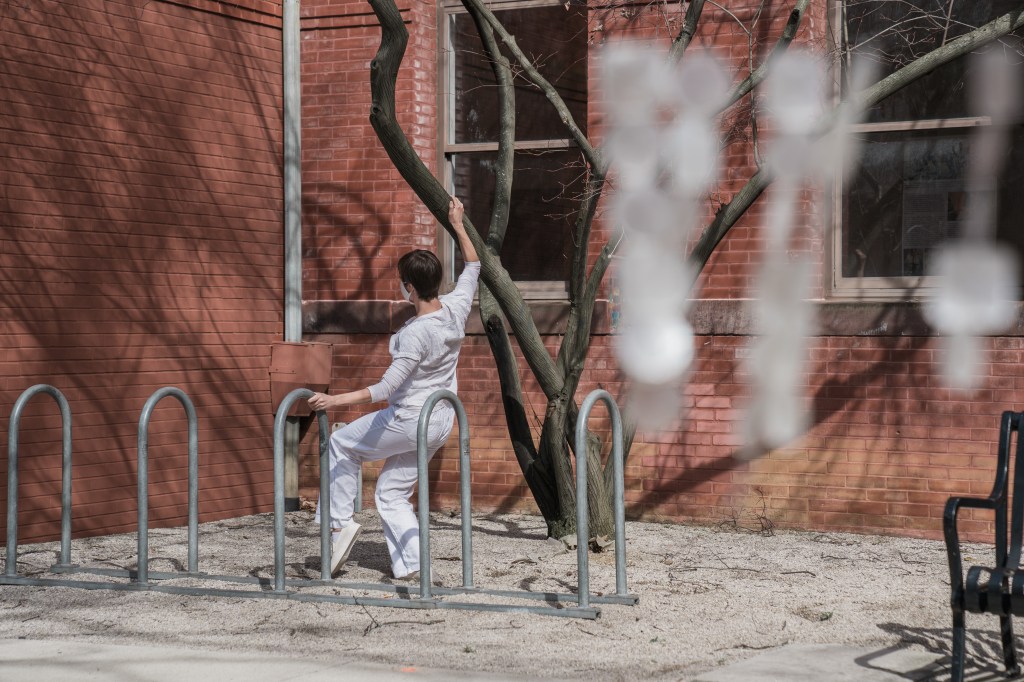
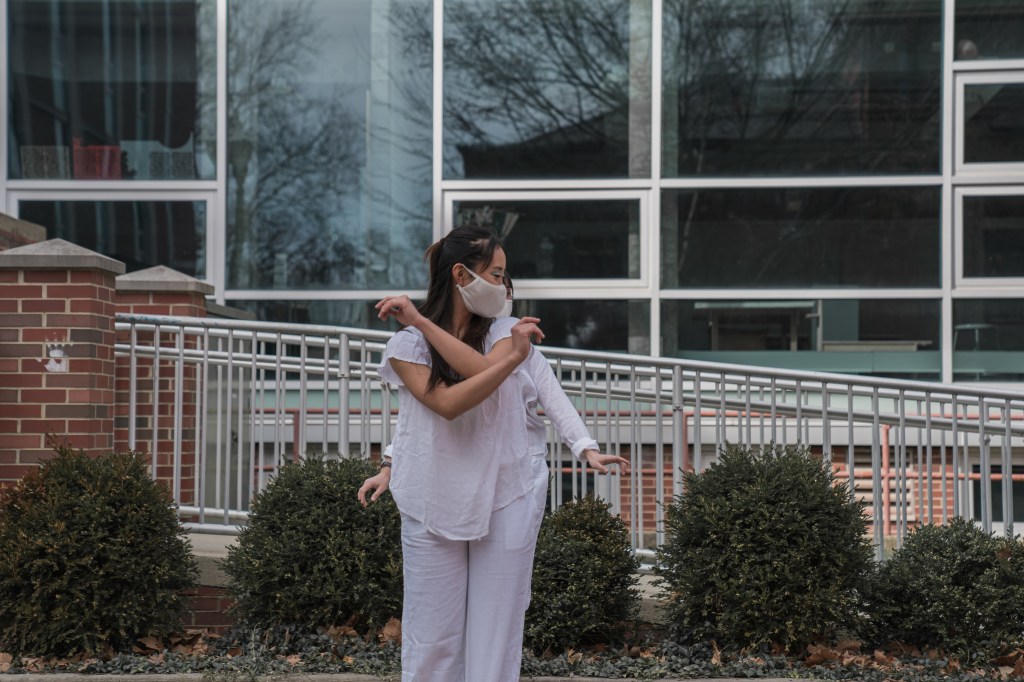
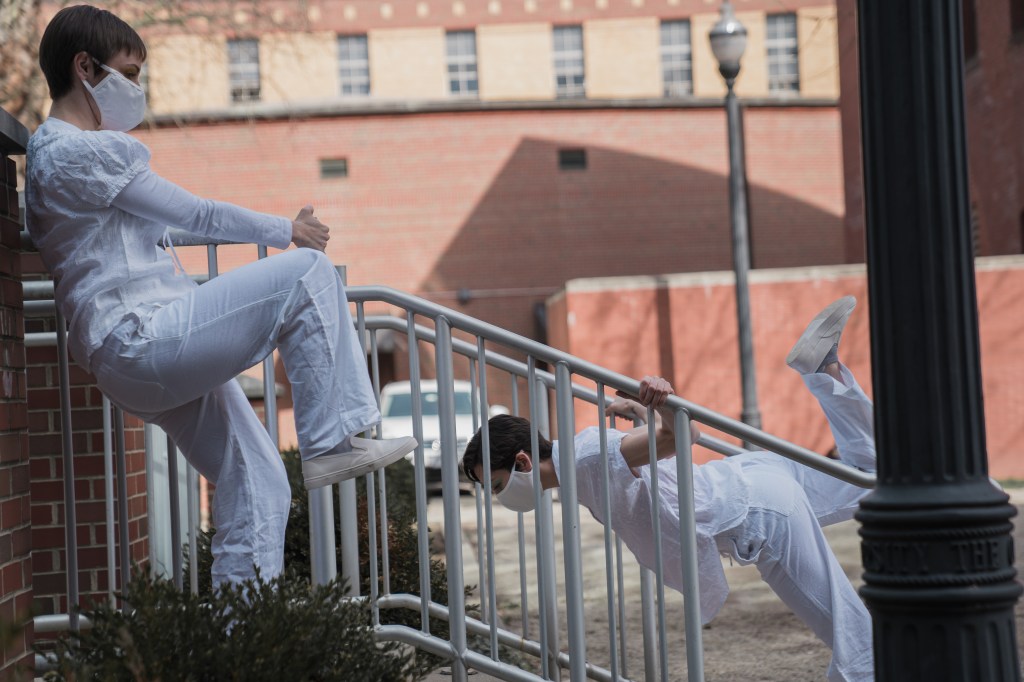
The performers were Laura Neese, Teddi Vargas (Senior at OSU dance), Michaela Neild (2nd year MFA at OSU dance), and myself. This time, Cellist, Sara Troeller, and make-up artist, Parisa Ahmadi also joined the team to elaborate the performance. We performed at the middle yard at the Hopkins Hall.
Photographed by Abby Koskinas
I joined them at the beginning of February when Columbus was covered with white snow. I remember the first time Laura, Teddy, and I went out to the site. The trace of the footsteps, trees standing strong and lonely, the warmth of the body under the coldness. After the exploration at the site, we created the phrase by using all the elements we witness. It was a reminder of the beautiful findings in nature even though after the snow melts.
We performed the basic phrase every time we hear the theme played by Sara. I really cherish the feeling and memory every time I dance this basic phrase. Sara’s music was adding another layer of inspiration and I loved how it weaved between 4 moving bodies and space.
All-white costumes stood out and emphasized the contrast from the architecture surrounding us. We also had bright-colored eye make-up which made me think about the joy or celebration of the arrival of spring.
Photographed by Abby Koskinas
As for the score, we had 5 minutes of stillness and 10 minutes of improvisation, a total of 15 minutes session 4 times. (I wrote down a clear explanation below. )
We separated the site into 4, Ramp, open space (looks like a theater), bicycle stand, grabble with chairs. And we spread out to each site for the first 15 minutes. The first solo was fully engaged with the environment. The sense of visual, touch, hearing drove my movement. The second and third were partnering. I had duets with Teddi and Michaela. Both duet sessions were always found surprise, excitement, and creativity. It also could be described as active listening, call, and response, or conversation. The last part is a finale. We all gathered at the ramp. I really enjoyed all of us get to connect and sense each other. Someone initiates and someone responds. We never knew what will happen, but our connections were strong enough to adapt, adjust, and create together. I felt the sense of community.
This process was never be forced to recreate. Laura allows us to jump into more possibility within the movement score and simply having fun move together.
<Score of the performance>
Four 15 minute cycles: 5 mins stillness/silence10 minutes movement and all begin with basic phrase.
Following with improvisation solo, interaction with environment, and interaction with each other, evolving over time
cycle 1:(theme plays) stillness
(theme plays) all start with phrase at individual sites, then explore individual impetus and interaction with site
cycle 2: (theme plays) stillness in between your sites I and II (theme plays) start with phrase -> partnerships at the sites, explore site with each other in mind
cycle 3: (theme plays) stillness between sites II and III (theme plays) start with phrase, evolve from there in new duets at your site III
cycle 4: (theme plays) stillness between sites III and the ramp (theme plays) start with phrase, explore ramp, interacting with site and groups
In Composition class with Professor Crystal Perkins, I had a chance to read the book, “Emergent strategy: Shaping Change, Changing Worlds” by Adrienne Maree Brown. From her Spell and Practice section, Visionary Fiction is stood out to me and decided to try out for myself.
The definition of Visionary Fiction is “a way of to practice the future in our minds, alone, and together” and enable us to connect the past and the future. In my opinion, the past gives a great lesson either sweet or bitter, so applying the lessons to the future-self will be helpful to lead the direction. The best practice of Visionary Fiction is writing.
So I would like to introduce about the workshop for practicing Visionary Fiction. The author of the book, Adrienne Maree Brown organized the workshop in May 2020 to cope with COVID-19 pandemic. According to her blog (Link in below), she described this workshop for activate the imagination. She invited people to work on prompts for 30 days to get to writing. It was worth reading through all the texts to see how she navigate to write the story. For example, her Day 1 prompt:Write a conversation between the virus and the crisis, which is quite unique way to animate the situation.
So what I would like to do is using her day1 prompt with a little bit twist. I wrote the conversation between my past self (A) and the future self (B). This is what I gathered so far.
A: Hey, where are you going?
B: I don’t know. Why?
A: Because that’s not where you usually go?
B: Excuse me? How do you know my “usual” pattern?
A: That’s not the point. I want to ask you why you are going there?
B: There? You mean here?
A: Here? I lead you to there.
Very simple, but it’s surprisingly deep. Please let me know on the comments if anyone tried this exercise to see what the past tells you.
It was a great practice for understanding the camera operation. The all angles are capturing exact the same movements yet, since I shot Ishy outside at the South Oval, I also noticed that how much lighting affected to the shots. Especially I enjoyed the editing aspect to create the whole choreography with only 2 movements. The limitation gave me a power of making something really pleasing. I had a clear understanding of the goal of this assignment and I felt succesful making 22 shots.
< Art Project>
This practice I really enjoyed it and I could say the film was successful to display my intention. The idea of 2D image into 3D creation is really captivating to me. The image I chose was black and white photograph taken by Ansel Adams, but it also connected to my childhood memories. So, the image itself was still, no movement inspiration whatsoever, yet I had the words, nostalgia and tracing to my home is in my mind to create the film. I chose Katie O’Loughlin as a performer since she is amazing mover as well as bold to try new thing with me. In editing, I noticed that I tend to overuse the layers, though in this film, it really worked well to tell the doubles or past self in the frame.
<Final: Fish out of the water>
My initial plan was to portrait my personal experience as an outsider from own culture. I wanted to keep the term “Fish out of the water” as a metaphor. Yet, I had a challenging time finding the performer who can display the struggle within their own heritage and now. So, I changed my direction to go along with the term, “fish out of the water” and created the narrative with Jackie that she had a daydream at the aquarium AKA fish shop. In this film, I used all elements that I learned in this class such as angles, musicality, key frames to make smooth transitions. The thing I regret is the dancing part. I had Jackie against the wall with the projection, and I shot her with many angles in different level. However, it turned out the lines of the wall creates the frame inside the frame. The film itself was successful to the audience to have a clear storyline as well as I could use all the skills I learned in this class.
<Reflection of the semester>
Dance Film I is one of the class I was excited to take in this semester. I was ready to dive in this class. At first, it was challenging due to all instruction and class time was online. I have only used iMovie so learning all the function that DaVinci Resolve have took time and many practices and fails. Although the speed of the class and video recordings helped me a lot to catch up. I watched couple times to fully understand the editing software. In terms of filming, I enjoyed a lot to find more perspectives by applying the angles, levels, the physical distance with the objects. I only used front view to record my dance work, but to allow myself to have cinematic approach, I saw more possibilities in film. Overall, I gain a confidence to say I have a fundamental knowledge of making film.
This semester, the class I was really excited to take was Intermedia Lab with Professor Norah Zuniga-Shaw. Due to the COVID restriction, we could not get inside of the Motion Lab, which I was disappointed with. Although I was so amazed by all the resources from viewing, reading, discussions, live events that she brought to the classes, the technology lab with Oded, and classmates who are bold to try new ideas, open to collaborating, and dive into the creative journey of unique, evoking, mesmerizing projects.
The first project I did was a “digital double” project with Abby Koskinas. She was a senior year BFA student in dance at Ohio State University. I build her doubles by interviewing her and ended up portraiting her rigidness for creativity, but spontaneous and adventurous personality. We streamed through OBS, a design and streaming application. Learning OBS was also a new way of creative thinking because I was used to horizontal timeline designing instead of vertically layered scenes with text, video clips, and audio. It was challenging, yet worth spending time and fighting to reach the level of I satisfied.
The most interesting idea that I learned over this class is creating sonic space.Hearing is such a strong sense to bring the sensation and connect to the memories or experiences directly. At the beginning of the semester, I tend to listen to songs written in Japanese. And realized that I was trying to make a safe space sonically. So from my experience, I was curious in creating an intimate place for an artist to share with the audience. Then throughout the corse, we had Voicemail “Pen Pals” Choreography for the Ears and Audio Walk at the South Oval in person which all inspired me. Another reference is Taryn Simon’s Assembled Audience. I visited the exhibition at the Wexner Center for the Arts at the beginning of October (The link below). It was an eye-opening experience! The darkness sharpens the hearing and the sound of crapping gives me the sensation of being surrounded by clouds of people.
My interest leads up to the second project, Surveillant Hall Audio Memory Walk. I partnered up with Abby Koskinas again to collect the memories of the Surveillant Hall from most of my classmates. I have always wanted to know what the dance building used to be before the COVID-19 hits so this project was like a treat for me. We started from the entrance and decided to navigate the audience by introducing each space from the 1st floor to the 3rd floor. Abby did an amazing job to contact other undergraduates to collect their stories. We actually went inside the building and calculated the time in between moving each studio, walking the aisle, and going up and down the stairs. It took a long time to put together all the audio files, although it was a really fun process. We wanted to corporate the video clips as well, though time was limited, and hard to obtain some clips from the Dance department.
Surveillant Hall Audio Memory Walk was the prototype of my final project. It is dedicated to the specific location and the memories attached to. I used the same structure but changed into my home town, Tokyo Japan. Started with brainstorming how I navigate the audience and decided to make an audio trip, “Safe and sound”. I came up with an idea while I was flying to Detroit, so I had a clear image to imitate the airline announcement. Then I started writing about my daily life in Tokyo adding my personal memories, waking up in my house, walking to the train stations, going to the school, getting snacks on the way home, and coming back to the house. I spent a long time researching online to find the exact sound that I wanted to use. After I have a solid collection of sounds, I put them all together on GarageBand. I did not have time to dive into learning Audacity so that’s the only thing I would like to go back and spend time more. My goal is to create an immersive, intimate, vulnerable experience to share with the audience.
Overall, I am very grateful for this class to open my eyes to technology and introduce me to new perspectives to present the artwork. This class pushed, motivated, and encouraged me to start with an idea to create even though you don’t know the direction you want to go. The maker should let making lead the way. That what I learned the most in this class. I will continue to be bold and say YES to the ideas and keep creating.
At the beginning of the semester, one of my 1st year MFA cohort, Mollie Wolf ask me and Jackie Courchene (same as 1st year MFA) to create a piece about no physical contact trio and reflecting our time under the coronavirus pandemic. She also had costumes, the yellow and white zipper jackets, pants, and matching yellow socks that we could use.
I loved her concept so I said YES! immediately. I have never collectively choreographed before, so it was a great learning experience. We all approached this piece with a different perspectives and backgrounds. For example, Mollie has already set a piece by using the same costume, but different idea. Therefore, we communicate openly until we all get to the point of agreement. We compromise and fix the direction when we needed to.
Our matching day! From right me, Professor Petry, Jackie Courchene, and Mollie Wolf
The speed of this creation was very quick. We started to meet on Fridays after the Choreography Workshop course. We brainstormed ideas of how we negotiate the space without body contact. Started with an improvisation game, one or two people trying to touch the third person and she avoid the touches. It created the narrative of seeking consent. Then move on to the basic phrase-making. We got inspiration from our new “normal”, sanitization, washing hands, put masks on, screening… During this process, we faced the question, what we want to portrait. Since we were reflecting the pandemic, we also made the scene called “transmission,” which at first was the virus were transmitting from body to body, but later on shifting to the transmission of fear of getting coronavirus. After the first showing, we also noticed that all phrases we created were mechanical and systematic therefore there was another question came up which how we want to add humanity to this piece.
The process was, indeed, a deep rabbit hall. Especially on how we want to conclude this piece was a hard task to tackle. We initially wanted to finish with three endings, Mollie as extremely against the protocol, Jackie as the follower of the protocol, and I as in-between of the extremes which was the most relatable character. Although in order to find the thread in between of all the materials we created, we rewrote the ending as a unison walk into the unknown future together. In order to finalize our narrative of this piece, we manually wrote all the materials into paper and visualize the order.
Mix and match the order
Also, this piece had huge support by the sound. Mollie designed it by mixing the song from Alva Noto and many sounds and voices from The Conet Project. Both are electric and industrial which created the mood of the piece. Especially, we pulled many counting voices in different languages from The Conet Project to show what we deal with in this piece was universal. Then we added Jackie’s partner, Jordan’s voice to be “the protocol,” which was an external source to order us what to do. The sound is the trigger for us to move on to the next scenes and controlled the emotion and movement.
Lastly, we struggled with the title. Professor Petry gave us an exercise to find the words chine to trace down or up to micro and macro ideas. We tried couple of times though finding the word to start the exercise was tricky since we had total of 8 scenes which all were different from each other and the thread to connect them all was Jordan’s voice, “the protocol.” Therefore, we ended up landing on using the protocol’s phrases to tell our story chronologically.
We concluded the project at the end of November. Looking back to the almost 3 months journey was a great ride. We had such a clear idea yet it took a long time to get to the actual product that we were satisfied with. We had to sit down and discuss a lot, wrote down all the ups and downs. It was worth fighting to reach the end. I hope you enjoy our piece, “Clear. Again. Proceed.” Please leave the comment below to let me hear your thoughts:)
Over the quarantine, I have started teaching Japanese online. And it was so interesting that while I am teaching the language, I relearned how to speak my mother tongue and realized the significance of the language. This experience inspired me to corporate my mother tongue and dance.
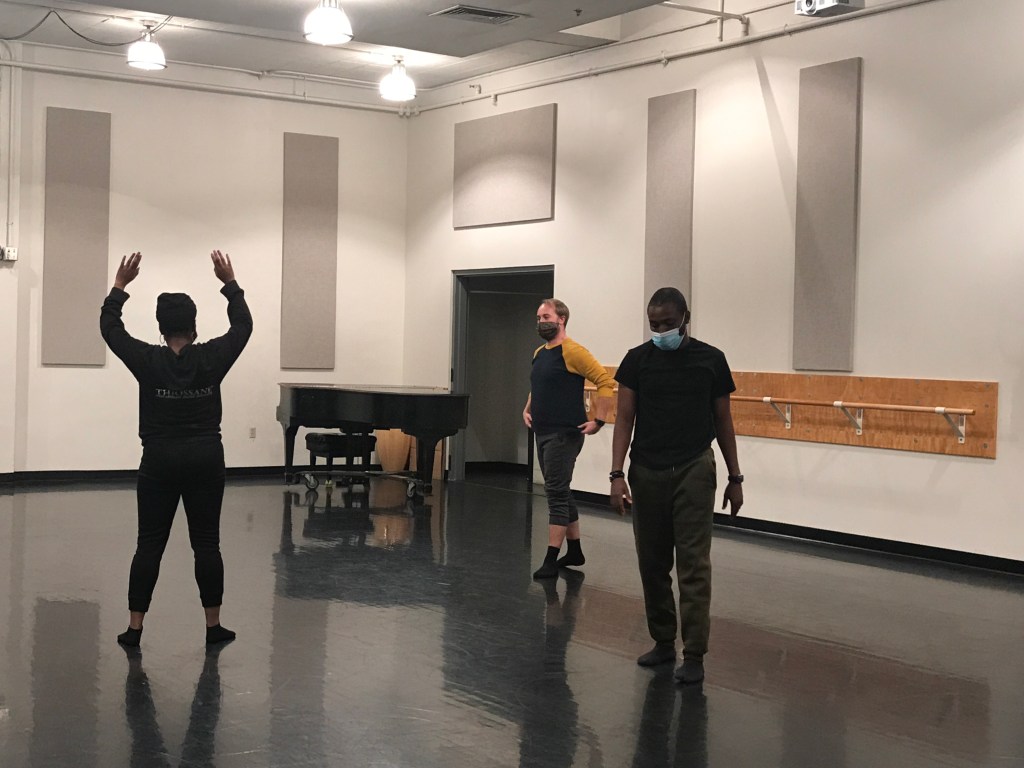
So I have a concept in my mind that “what if the dancers heard their own story in a foreign language, what movement comes out?.” It was on Friday, after the Choreography Workshop, walking the aisle with John Cartwright, Ishmael Konney, and Quianna Simpson. I asked them if they were interested in working with my concept. Fortunately, they said YES! So we started meeting on Thursday afternoon to rehearse.
At first, I asked all of them to write a paragraph of their self-introduction. I translated the texts into Japanese and recorded them. Dancers danced with their own biography, which they could guess what I was talking about, yet it was hard for them to fully understand. Quianna shared that she recognized some words such as”African dance” but she was influenced mostly by the rhythm of speaking. Also, John mentioned that it was dancing in between familiar from and unfamiliar. Next step, I asked them to dance with other’s bio which they have no clue what I was talking about. Ishmael shared that he was inspired by the speed of my speaking and almost echoing with his body. Dancers were definitely hard to react to speaking voice with unknown topics since no connection nor inspiration to their movement. What they react was the sound, rhythm, tone, speed I made. It was a great discovery to me since I was seeking an authentic reaction from dancers to the foreign language.
So we ended up using their biography with my speaking to generate the basic phrase. In the first version of this project, I was a narrator and started speaking Quianna’s story, then John’s and Ishmael’s at the end. The person who was spoken one’s bio leads the movement and others echoing. It was a clear structure of displaying how dancers embody the sound of Japanese.
Although, we received feedback about I and dancers’ relationship as well as an objective of this project. We discussed one more time to clarified the intention of this project and landed on offering a foreign experience to the audience but also showing the visceral level of communication. Also, we decided to not separating me from their narrative. I added on my story to move together as well as bringing back idea, authentic reaction; dancers react to what I spoke without knowing the content. We revised the movements, and space usage as well.
Over this process, we re-defined the fundamental of communication by using verbal and non-verbal tools able to understand, interact, respond to each other. Once Quianna shared that we seemed like creating harmony by bodies, which was a beautiful way to describe our creative journey and indeed it was a deep and interesting process. I would like to continue experimenting to combine my mother tongue in my work.
In the beginning of the semester, I had many questions related to “home” such as what defined “home”? Is it the location like where I grew up? Or the people such as the dance community at Ohio State University? Or the memories in my brain? etc..
Wherever I go, I can make some place for myself to be comfortable. But this comfortableness is not necessarily defined as belongingness. In my definition of belongingness is inherent desire to be accepted by the community by behaving what they expect to. I always have hard time finding a place to land myself. In the Japanese community, I am an outsider. People my age graduated from college, have jobs, live nearby their parents, mostly staying inside their country for the rest of their lives. On the other hand, I live in the U.S. which far away from all of my family, and still a student. I clearly not on the same pathway as others. In the U.S., I am a minority due to my race and skin color. I have a neutral opinion about politic, or economy which seems like unusual in this country.
So I started looking for uncomfortableness from lacking belongingness in the physical body. I had the privilege to work with a talented dancer, Aya Venet. She is a sophomore at Ohio State University, also from Japan. She was born between the father who is African American and the mother who is Japanese.
Rehearsal at the studio
We started to brainstorm what makes us hard to find the belongingness. We met once a week at the studio and built the narrative of the piece. She shared the story that in between of two location, Japan and the U.S., she is uncomfortable to be “her” due to the different expectations. Started with improvisation with the question, “if you are very uncomfortable, how do you move?”The movement was developed to embody her internal struggle.
I had her move inside the circle, which stands for a borderline from the place she is at. What I wanted to emphasize on the circle was that it was not her choice to be inside of it. The line was drawn by an unseen force, to categorize her as an outsider. The white line was inspired by field chalk at the elementary school playground. It is drawn clearly to stands out the separation, but the more you step on it, the more the line gets blurry. This applied to her circle, the more she steps on the line, the more she has access to the outside and merge to the inside. The line will dissolve and disappear. That is my goal in this piece. Showing her strength and able to erase the lines and step out the circle.
I planned to stage this piece as a film because I want to show the external factor, which affect her to struggle internally. I initially wanted to ask volunteers to walk around Aya, although due to the COVID-19, it was not a good time to ask this favor around. So I decided to overlay the video clips my friend took for me a year ago. They were taken at Shibuya crossing and Shibuya station which is well-known place for thousands of people passing every day. The clips was a symbol of the place where always required to catch up with the speed, and match with the expectation.
We searched the location and decided to shoot at The Oval. The red brick contrasted well with the white lines and I loved the background. To me, the two roads behind her were the two countries Aya grew up and came from to be who she is now. I did one take for drawing the circle as well as the ending part. Which made me worry that if I could take a good shot, but I trusted Aya and she performed beautifully. I hope everyone enjoys this short film. I would like to hear what you see and what you feel, and please share your thoughts on comment below!:)
Last weekend, I was fortunate to be part of the performance, Tethering Iteration 1. Laura Neese, 3rd year MFA student was showcasing her thesis process and I was one of her performers. From my understanding of her research is an investigation of durational change in movements, human relationships, and the environment with an anatomical perspective.
My process with her started back in early September. I met the other dancers, Tori, Teddy, and Madison through zoom for the first time. In the first session, she told her process and introduced breathing exercise, which I really loved. The exercise was to open the space in the lung to release muscle tension. It helped to breathe deeply by focusing on lobes (There are 5 lobes, 3 on the right side and 2 on the left side). We put the hand on the closest place of the lobe to feel expanding and shrinking. And just breathe a couple of minutes. Breathing is an essential part of human being, but we tend to forget how important is. Her process was, at least for me, centering my mind to the body and having a conversation with. Because I realized how much I overuse my body to live in this high-technology society.
we wrote down 5 things what we learned over the practices and kept as a reminder
After the first session, we met two days a week in person. Fridays at the studio and Sundays at the Chadwick Arboretum North. On Friday mornings, we started with solo improvisation to listen to the body. Then, she introduced couple of exercises, corporate nerve system and the body movements, the washing (improvisation game; one person keep walking as a washer and others can stop, dance, or walk with washer with their own choice.), non-associated words game, mirroring, walk or pause. All exercises were connected to research on how we move as individual but also as collectives. We improvised most of the time. In the end, we did free writing 2, 3 minutes to pin down our running thoughts and we shared. This morning ritual every Friday helped me to cope with the exhaustion of the week and translated into refreshing dance investigation. On Sundays, we started walking around the lake to ”notice” what you notice. It was a brief 15 minutes walk, but it was enough to sharpen and tune my senses to my surroundings. Every walk I encountered, saw, and heard different things such as color-changing on the leaves, people who came to fish at the lake, or the sound of cars running by the park. We created the base phrase out of our walks as collective and we used and manipulate it in the environment. Laura chose a space where on the right side of the Encore house with many trees. I have never done site-specific practice so these Sunday practices were interesting to me. Because our improvisations were never the same, it kept growing and changing. Even though we were familiar with the phrases, exercises, or the surroundings, we made choices and moved differently. What most strikes me over the practices was Lauraallowed us to change, influence, and be affected instead of clinging to recreate the beauty of making.
While we practicing, we as 4 dancers were paying attention to our distance due to the COVID-19. So the question was “how can we dance together or connect each other while we distanced?” This question is common among dance artists under this pandemic. However, Laura Neese solved it beautifully. As I danced more with dancers, we built trust and recognize each others’ character deeply. Gradually we understand our own movement patterns and inspiration source built the network to communicate without contacting physically. One time Laura told us that “we are building an invisible chain connection to communicate like a root of the tree or human DNA.” We all were already open-minded and ready to dive into her process, although how we built aninvisible bond over the time of practicing improvisations together were stronger and more intimate than we started.
After the show on 11/1
It was satisfying but also very sad to admit that the journey with Laura and 3 dancers was concluded, though what I experienced through the process was a gift to me. I appreciated being able to participate in her process as well as the performance opportunity.
If anybody would like to know more about Laura’s research project, please click the button below.
In Dance Film 1, Professor Mitchell Rose said “there is nothing new in this world.” I was shocked! But it is so true that something human has been expressing either by films or music or dance is the same theme over and over again. We as humans are facing the same theme of life, but experience it in our own way. Also, he said, “but there is only you in this world” which means I can have the original viewpoint which no one can have. This encourages me to find uniqueness within me instead of looking outside and comparing what I am lacking. Since the beginning of this semester, I have been thinking about what I can bring to the dance community at Ohio State University. So, my interest is I would like to comprehend my artistry deeper and it is evolved into my first research topic, understanding self-identity.
I am hoping to learn self-identity by investigating Japanese heritage and the life experiences that I earned through the travels. First, I would like to reveal the relationship between dance and Japanese culture by seeking the answers to so many questions that I have not solved yet. Such as how Japanese people embody their culture through dancing, what movement is defined as “Japanese-ness,” and what makes me push to study contemporary dance abroad. Also, I am very curious about foreign experiences in the body, locations, relationships, and lifespan and what makes people decide to stay or leave from there. Foreign experience is always part of me where I go and I have been wanting to unpack my emotion and thoughts through migration from Japan to the U.S. And I am focusing on Issei, who born in Japan and immigrated to different countries, performing artists specifically. It is because one, I might be a possibility to become one of them, but two, it would be great to bring objectivity in my research. I would like to investigate the artists’ hybridity of cultural identity as in how they have been creating their “home” at the new place, people, culture while keeping their roots, customs, and tradition at the same time.
The second is the nature of communication. I have noticed that word selection is very sensitive especially in an academic setting. Verbalizing is a huge influence on creating meaning, culture, mannerism. Even though dance is called non-verbal communication, it has different movement vocabularies in different dance genres. Over the quarantine, I started tutoring Japanese to kids to the graduate students. And I have noticed the similarities between teaching language and teaching dance. In dance class, everyone brings a different language through their bodies. It is like everybody speaks a different language. So, I am interested in how I as a teacher can strip off the specificity of terminology and able to communicate on a visceral level. My goal is generating a way to hybrid the cultures brought by everyone in the classroom and to create one dance language to speak as a whole class. In order to reach this goal, I would like to synchronize my study in Japanese (as language) and dance pedagogy. By establishing the common dance language will help to unite the people beyond the borders in the future education setting.
I am still on the stage of brainstorming yet, getting clear each day. I am very excited to work on my research project! Please let me know if you know about the resources related to the research topics on comment below. I appreciated any comments, suggestions, and ideas:) Thank you!







 Yukina Sato