It’s already at the end the end of the year 2023. What a year of CHANGE! Since graduation, my life has hugely shifted. I felt like I almost lived two lives in a year, the first half as a graduate student and the other half as a dance faculty.
After I graduated from Ohio State University in May, I moved to Mankato, Minnesota, where I started as an assistant professor in Dance at the Department of Performing Arts. Learning new theater and dance department ecosystem, adjusting the new school schedule as a faculty, adopting the cold Minnesota weather… All happened in less than five months. It was a huge learning curve to be an instructor of college-level movement courses with various students, not only dance major students but also Theater students and dance minor students with different movement backgrounds. I aim to offer a class where students can feel safe to be curious, explore, and deeply listen to their bodies and internal desire to dance. Ultimately, I want my students to look forward to taking classes. I wanted to write it down here to remind myself of the future -Where I started and what dance educator I want to strive to become.
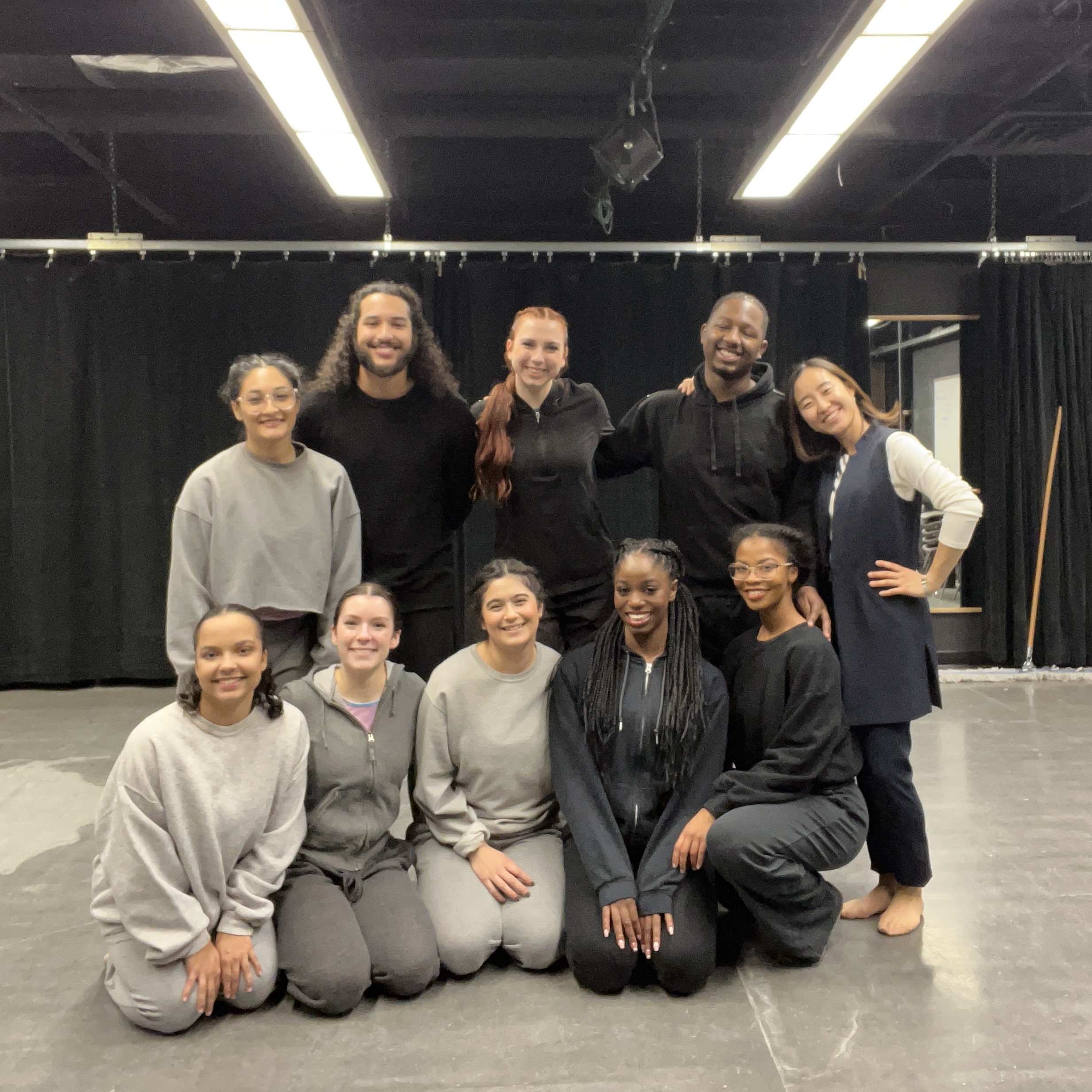
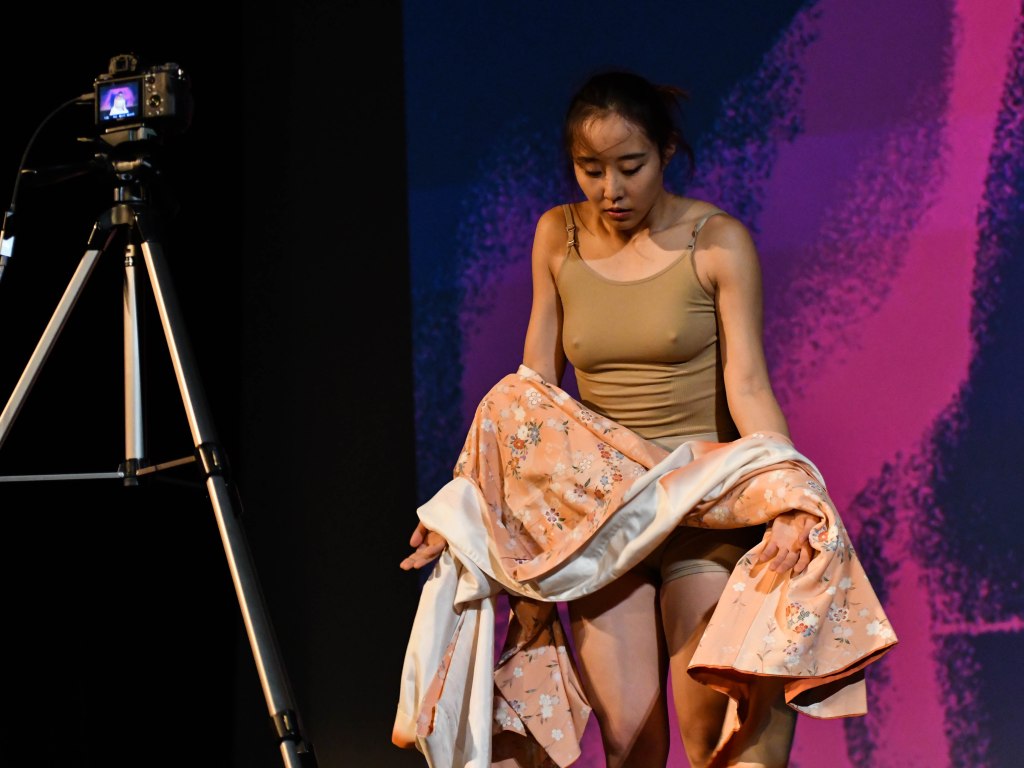
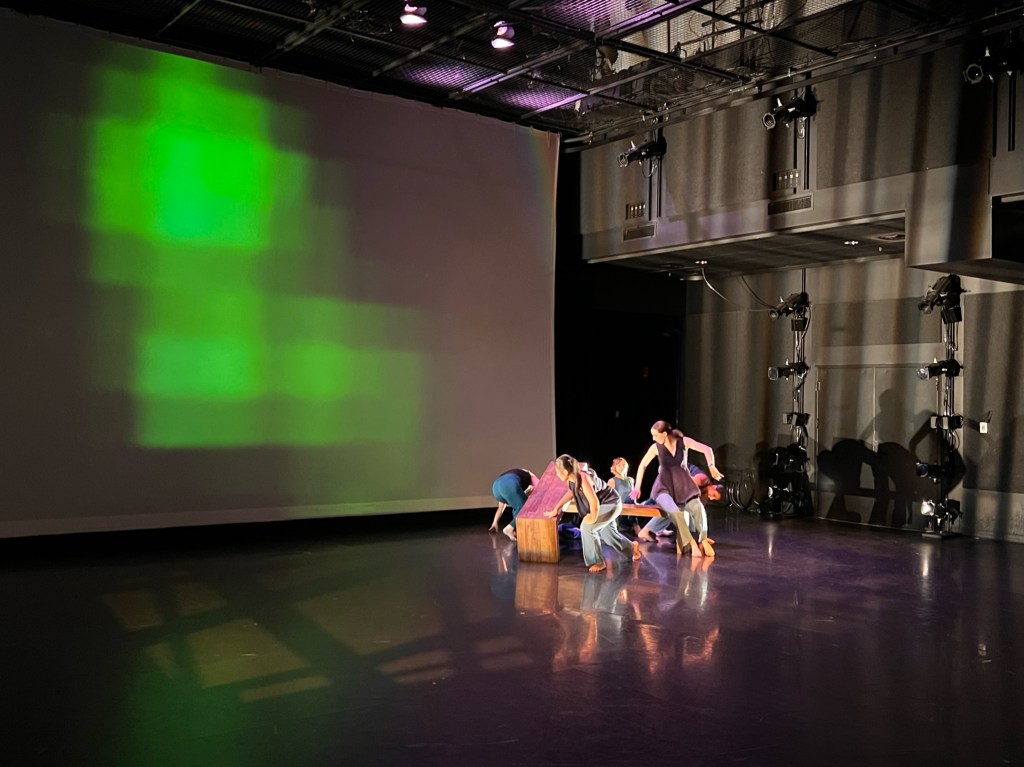
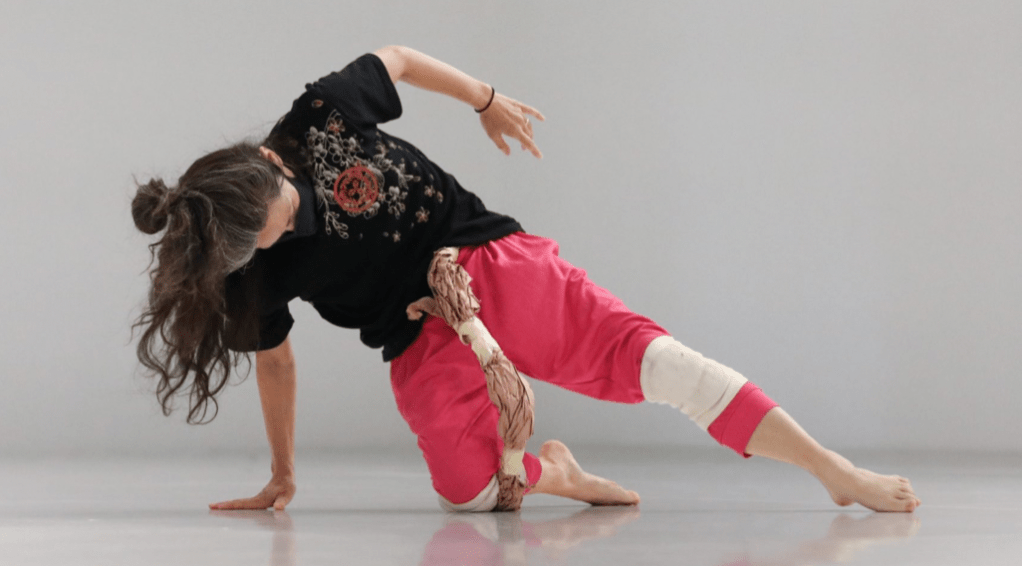
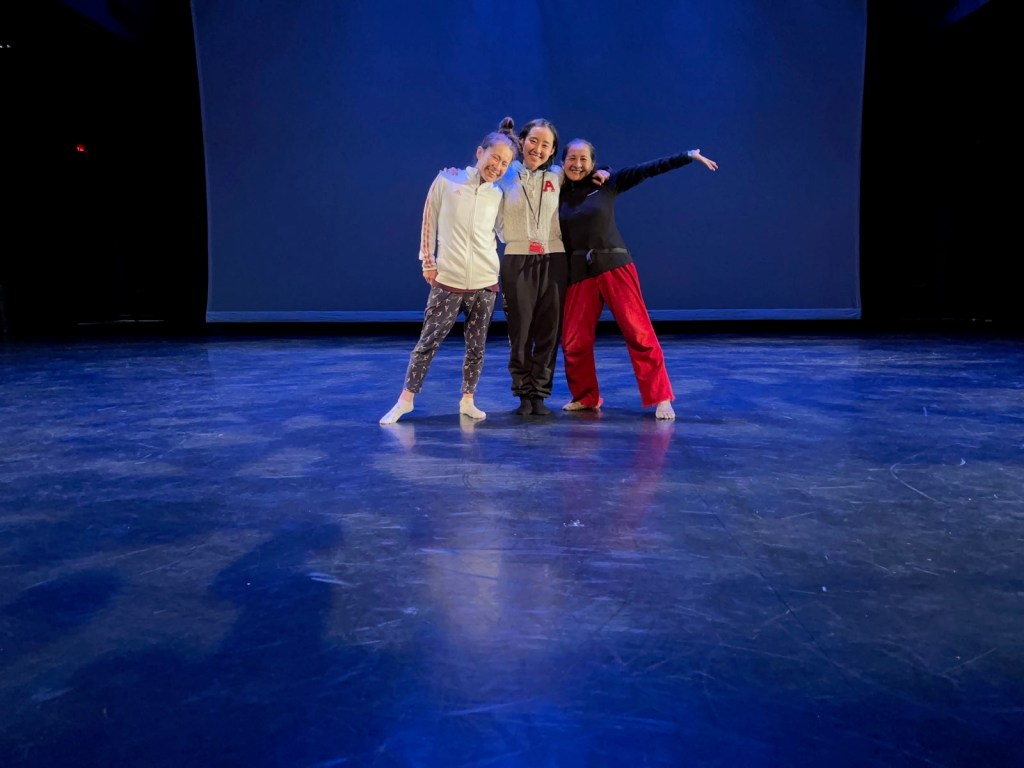
Photos from the Fall Dance Concert 2023
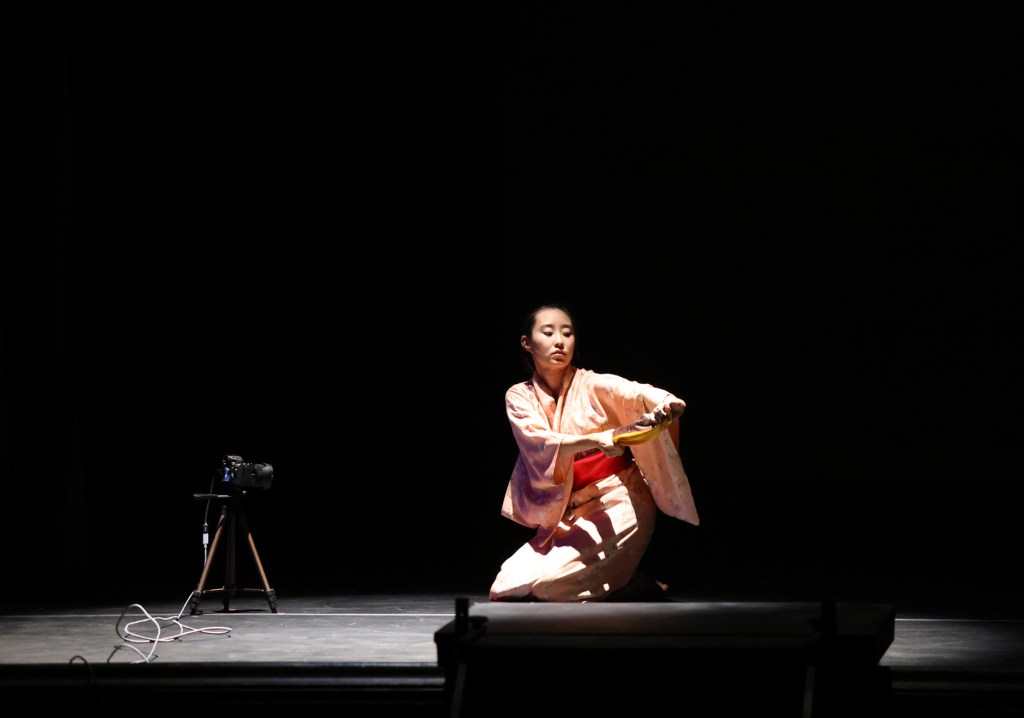
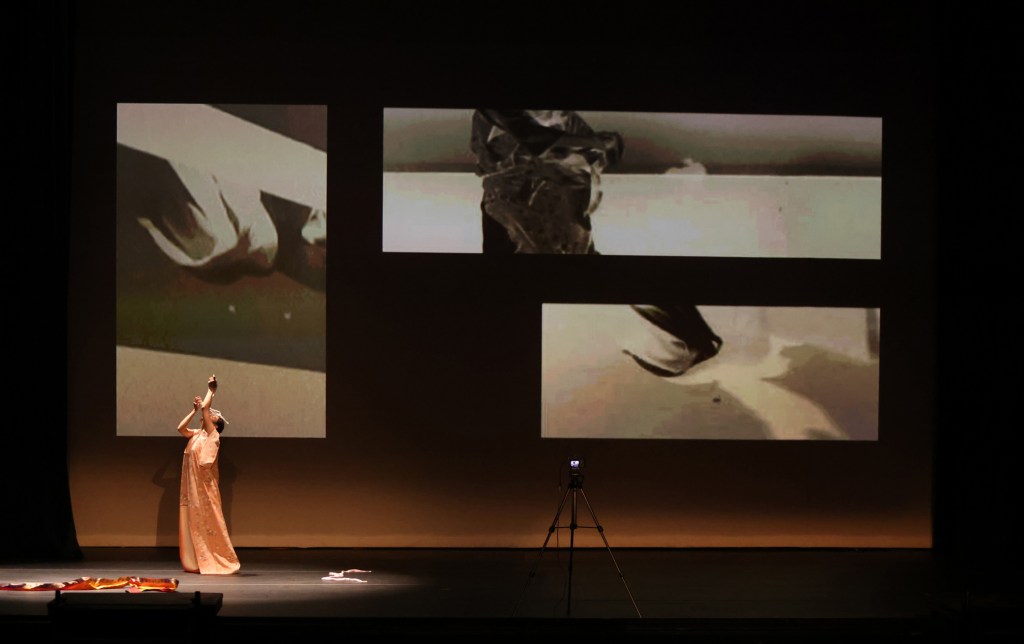
I also would like to mention some of the choreographic projects I participated in this year. I was honored to be chosen as a dance artist to perform outside of the school system. Yujie Chen and I performed “Motion of Seeing” at the Detroit Dance City Festival in September. This piece we created was the second iteration of “Body Negative” and it expanded the idea of mobility in seeing the performance. I also deepened my choreography to think about how BIPOC artists deal with cultural representation. We received the National Exchange Award. Even though I am still in search of my artistic voice, such rewarding to share and recognize dance works that My collaborator and I put the effort into.
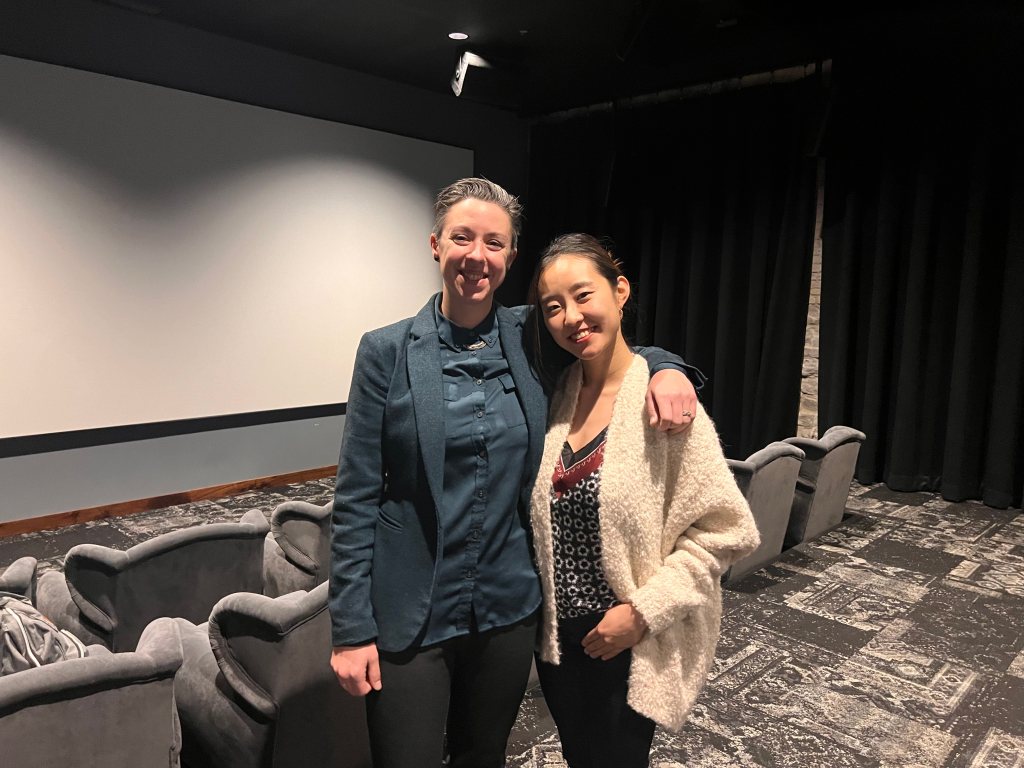
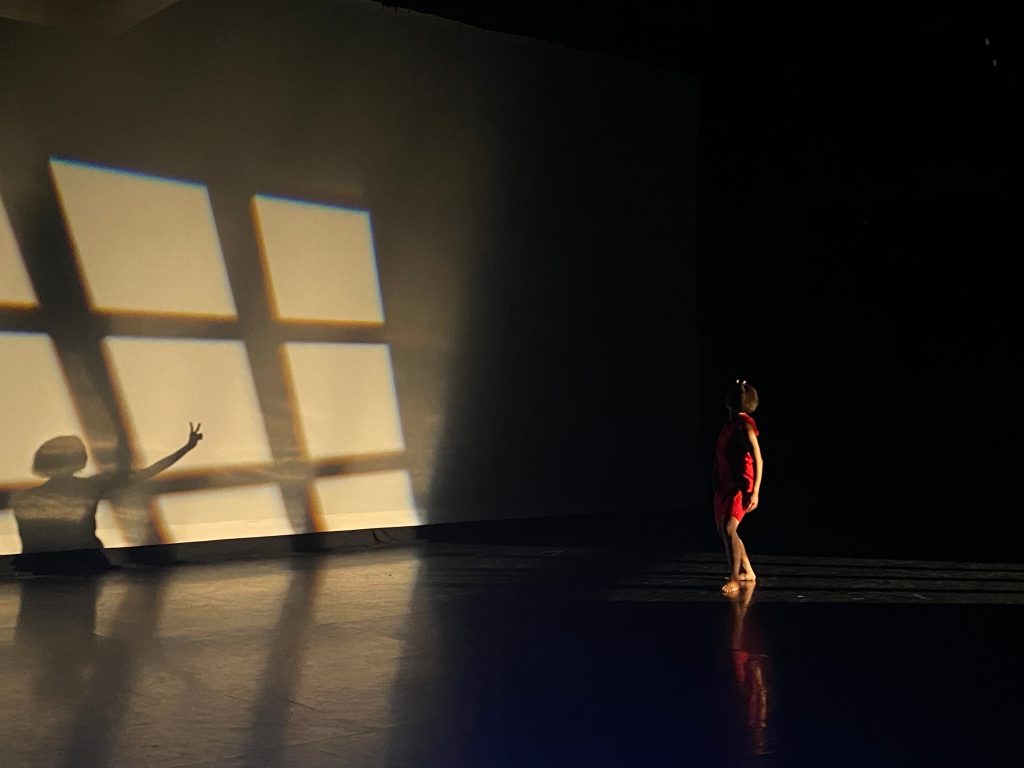
Photos from the performance, “Motion of Seeing” at the Detroit Dance City Festival
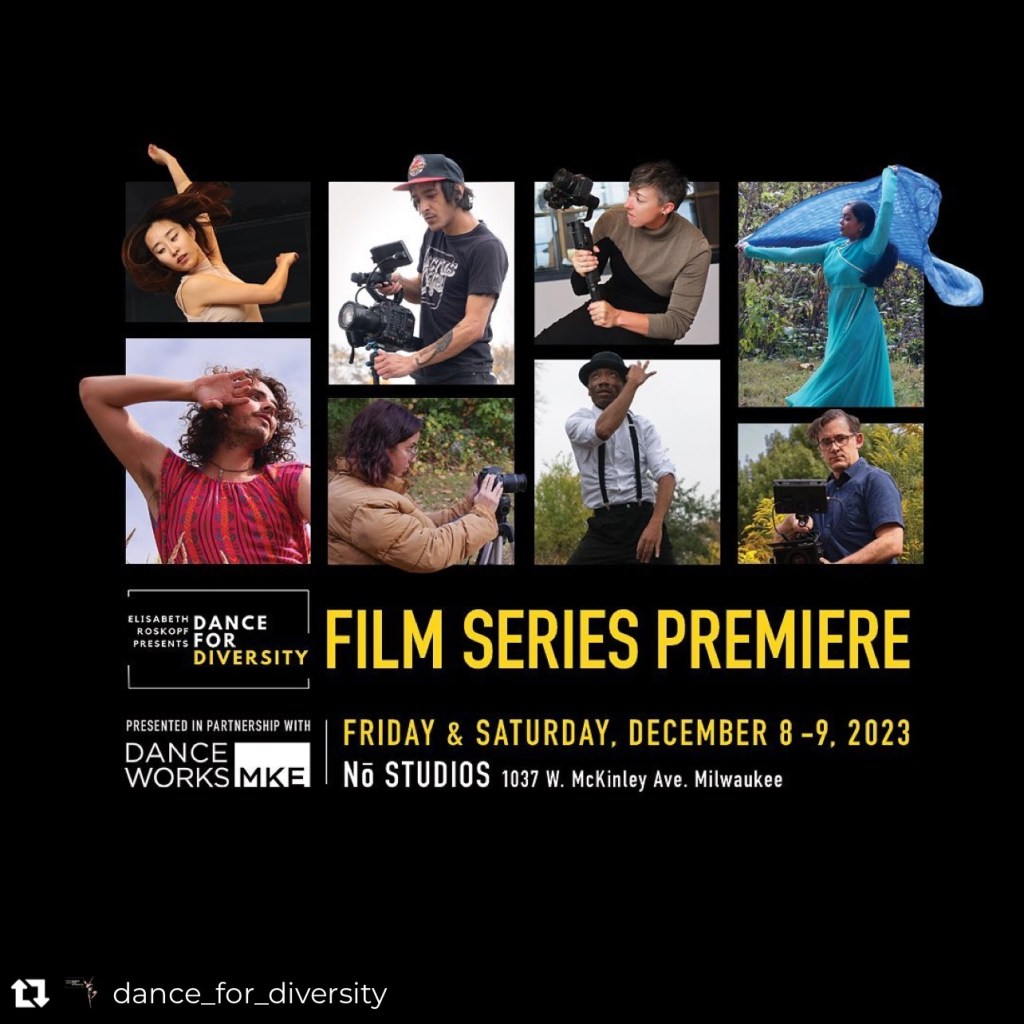
Another chance that I could explore my artistry was through dance filmmaking. I was fortunate to be part of the project, Dance for Diversity. Dance for Diversity was founded by Elizabeth Roskph and envisioned to amplify visibility and create a platform for BIPOC Artists to center their unique voices and their stories through their art while fostering a place of belonging and reclamation of their true identities. I had the privilege to collaborate with the videographer, Rachel Malhorn. I had an idea of visualizing in-betweenness that I experienced as a first-generation immigrant. I wanted to showcase the acknowledging upbringing and how we adopted, changed, and merged our living experiences in different cultures to live in the U.S. For 4 months, we had great communication back and forth to discuss creative direction. We filmed all the materials in Milwaukee WI in 2 days and assembled the film. The level of understanding and trust made us create a dance film, 藍 (Ai).
Photos from Dance for Diversity, at the Film Series Premiere
I want to conclude this post with appreciation and hope. The job and many choreographic projects that I participated in were extensions of what have learned and inserted in working with during my graduate time. This year gave me confidence and autonomy in what I want to do. I hope to expand and grow more in 2024.
It has been a while since I present my thesis project. However, I would like to reflect before I move on to the next stage of my life. My thesis project, “we carry to depart” was premiered in February 2023 at Barnett Theater at the Ohio State University. The creative process took me almost a year and a half to complete. The journey felt really long but super short at the same time.
My research interests started from a simple question, “How do we define ourselves?” There is a past that shaped us that reflects who we are yet it will not define who we are. For example, I grew up in Tokyo, Japan. The fact that I was born and lived there constitutes how I see the world in a certain way. However, it does not mean that it 100% defines a current me, who studied dance in the U.S. for 7 years and has absorbed various cultures. It is part of who I am.
As a dance artist, during this whole three years of the MFA program, I was in the endeavor of looking for “who truly I am” and what is my “authentic” artistic voice that represents Yukina Sato. I came to the graduate program straight from the bachelor program. It is a rare pathway for people pursuing a career as a dancer. However, this opportunity gave me a place and time to test, fail, explore, and seek what I really want to do.
The key term here is authenticity.I viewed and investigated myself from both outside and inside. From the external point of view, I questioned how I am perceived by others. What community do I belong to? How society defines people in categories, called identity. From the internal view, I asked what shaped me into who I am. Is it the people around me, the space I live in, my nationality, or my body?
Also, dance is tangible but intangible in a way. It requires the physical ability and duration of time to describe intangible things. Always battling with time and ideas. If you exist in the dance industry where so many people have tried and executed various amazing ideas and creative approaches, what you can do? What makes you absolutely unique? How you are in conversation with the past, current, and future?
The thing never changes where I go, and who I am interacted with, are my mind and body. The accumulative experience and memories are stored in the mind and they are unfolded by the body. How do we unpack this complexity of self through body movement? For me, the process of accumulating was unconscious. Therefore, it took me a long time to unfold them.
In my second year, I focused on my present self and created the practice of “body-doodling.” Every day, I took time only 1-2mins to log the location, time, and sensation. And I created a short phrase inspired by the daily record. So if you do it for 7 days, it creates 7 phrases. The practice of dailiness of making and tuning into my mind and body. One example was
Shaky legs Hugging the void Pacing fast Lost the sound of shoes Scared to go out in the lights I wasn’t full
Then I also invited 5 dancers with me to try the same exercise. My interest was to examine the various perspective on archiving themselves every day. Also, questioned how to log ourselves daily to trace the change consciously.
This practice informed me to move on to the next step. During the daily log, the most impactful part for me was where I reside in my body. If I was laying on the grass or sitting on the dining chair… where my body created very different sensations, emotions, and thoughts. It could be I would be in the space because I had to do so and so that day, however even though I did have control over my schedule, my body was affected by the “space”.
I have talked a lot about “space” in the last blog post. For my thesis project, I focused on the physical space such as a classroom, a city, and a living room in the house. Especially I deeply searched the location I grew up. In December 2022, I had a chance to be able to back to my hometown after three years since COVID-19 hit. I felt the hometown was no longer what I remembered. Everything looked, heard, and sensed new to me. I visited many places that were memorable to me and videotaped the locations. Also, I recorded many soundscapes. These files created a distinct outline of the piece.
In the last year of my MFA program, I was super fortunate to have 6 dancers with me to play and experiment together. Some dancers had been working with me for two years! They were willing to be with me ups and downs. I was immobile due to my knee surgery in Autumn 2022, so it was really difficult to know exactly what I want during the rehearsal time. I asked dancers to try many prompts and improvisations. I sometimes lost in experiments or composition, not liking what I suggest, finding interesting movements, or back to scratch. (*I don’t think not many artists don’t disclose how rough the creative process can be — Just a thought…)
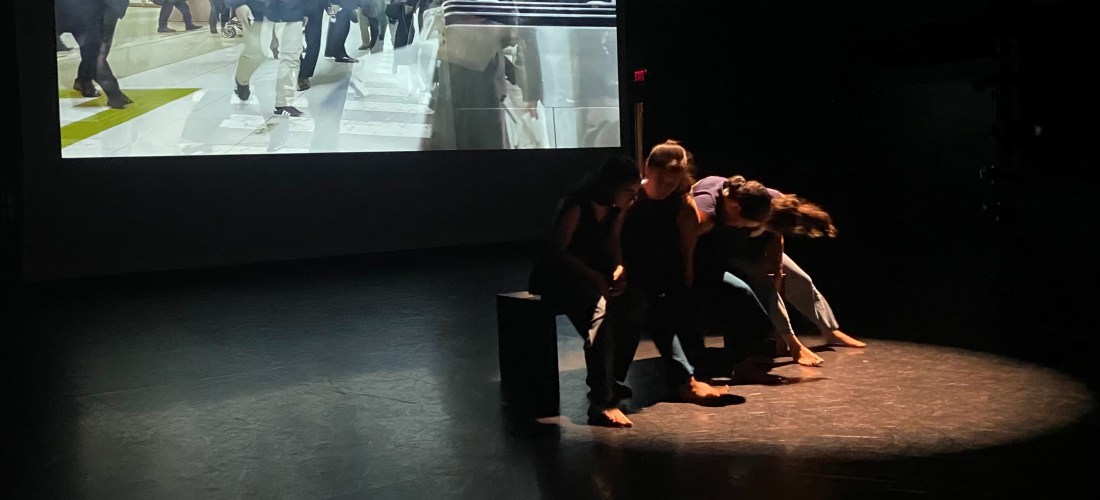
The piece starts at the train station. There is a video of a train departing playing in roop in the background. A dancer, Aya Venet sits on the bench, waiting for the train. “ガタン、ゴトン…(the sound of the train moving)” Then the backdrop video infuses more video clips at the stations and crossing in Tokyo while more dancers start to walking across the stage. When all five dancers sit on tiny benches, there start pushing each other to claim their own spot on the tiny bench. Transitioning the train station to my hometown, where many waves of people walk directly to their destination. The kinetic energy of urban life was embodied by five dancers through simple walking back and forth between two benches. The synchronous sound of feet, non-stop walking back and forth, and direct and intense focus was formed by the walk.
A dancer, Yitong Chen disturbed this established system by walking across the dancers. Yitong’s movement sparks on the stage, shouting “1, 2, 3, 4!” and transferring their energy to others. All the movement was extracted from the so-called box phrase. The number 1,2,3,4 is the surfaces or directions of dancers’ orientation on the stage. And specific number is in relation to specific memories with family members. Their movement becomes bigger and travels across the stage. More spreading their range of movement and suddenly a dancer, Rani Bawa, who only keeps walking shouts the frustration, “AHHHHHHHHH!!!” The frustration comes out from being alienated from the group. This section represents how people establish the system and the reality of whether some can adopt it and or not. Her shout transitions the scene to the physical space created by two benches, representing Japan and the U.S. Dancers leap over and push and pull them, and the distance between benches gets closer and closer and makes them blend into one long bench. Then, dancers transform benches and create many different spaces such as a slider at the schoolyard, a hiking trail, a dining table in the kitchen, and lastly a small closet, where I hid many internal emotions, trauma, and thoughts.
Coming out of the closet segways to my solo. I travel across diagnose from the left corner to the right corner. Each movement represents specific life events and memories from the day I landed in Oklahoma till the current moment. When I reached the right corner, two dancers, Kara Philoon and Aya Venet enter the stage. Their duet consists of many weight shifts. They represent the relationship between mother and daughter. The mother supports the daughter but eventually, the daughter has to leave the mother and move forward without her. I incorporated my experience of recovering from a knee injury as a method of slowing myself down to reflect on my relationship with people around me and myself. The rock music start kicks in and as the duet finishing, I am blasting the energy on the stage. Throw my body out, kicks and turn, flipping my arms around… it is the internal pain and acceptance of what I become. The dancers observed me from a distance on the stage. I slow down the movement to take out the knee pads and give a piece of them to each dancer. The knee pad stands for my shed skin, a part of my body. I give a piece of myself to my dancers as members of the collective identity we created throughout the piece.
The last unison showcases my movement vocabulary which consists of influence by six dancers and what I have been trained and learned. It is a mixture of the past and the embodiment of the current self. And all dancers drifted away from the right corner to the left corner leaving me alone on the stage. They carry each other to leave me behind. The last scene cites the very beginning. I stand in the same spot that Aya was sitting down and rephrase her movement in different ways how we create the space and how I leave the past behind, how I carry forward and depart to the new chapter of my life.
This piece is the creative process and archive at the same time. I feel like it made me realize the power of dance-making and how I want to embody my vision as a member of the human race.
At the beginning of 2022, I started to reach out to many Japanese female dance artists in the United States. Because, over these 7 years of staying in the U.S., I realized how important to understand my upbringing in terms of refining a relationship with my cultural identity and dance-making. Therefore, I looked for someone who shares a similar background as me and is able to tell the struggles and success stories with me.
When I came to the undergraduate program in Oklahoma, I was the only international student, Asian student in the department. I was super visible and aware of my skin, body, and how I move. Regardless of the visibility of my ethnicity, I had never met anybody who immigrated from Japan and pursued a career as a dance maker. I also started to figure out that I have the ability to sense and understand the choreographer’s mind. For me, dancing to someone’s choreography is some kind of translation and also a transformation of myself to be their voice. On the other hand, dance-making is embodying my own creative voice. It was more difficult to process than translation. I felt I needed some assistance in understanding what is my creative voice, and how to polish it.
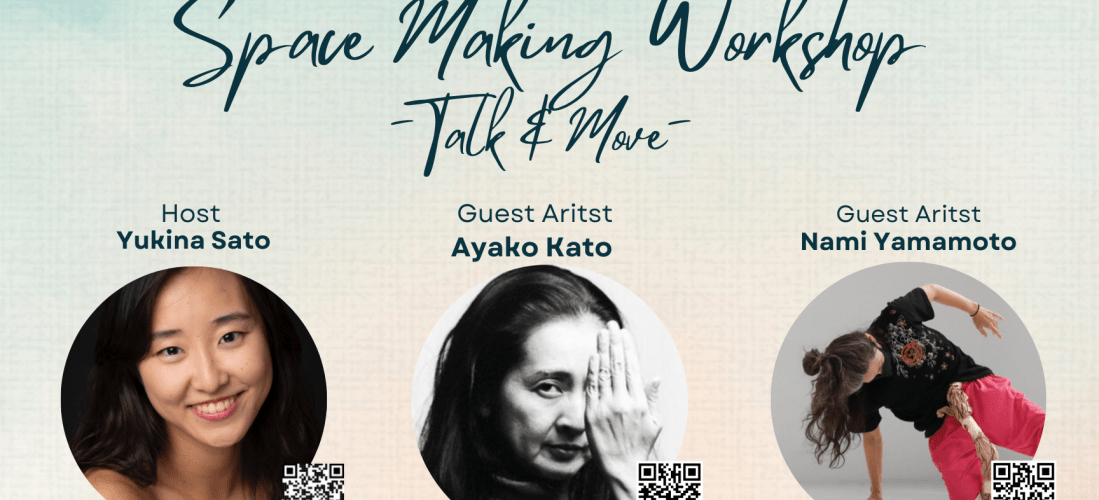
The generous artists named, Ayako Kato (Chicago IL) and Nami Yamamoto (NYC, NY) are willing to share the stories of their careers in dance-making in the United States. They are born and raised in Japan, and at some point in their life, they came to the U.S. and decided to stay here in the U.S. to pursue dance-making. Their decision itself is super brave to me but also they have been actively making work. Nami is awarded by Bessie Award in 2017 for her work, “Headless wolf” and Ayako just completed her performance series Ethos started in October 2022.
Photo: Nami Yamamoto (Left) and Ayako Kato (Right)
I communicated with them over 5 months about the idea of hosting a workshop to connect us as well as share their story in a public space. We named as “Space Making Workshop” to invite people to experience Nami and Ayako’s dance practice and have a conversation with them.
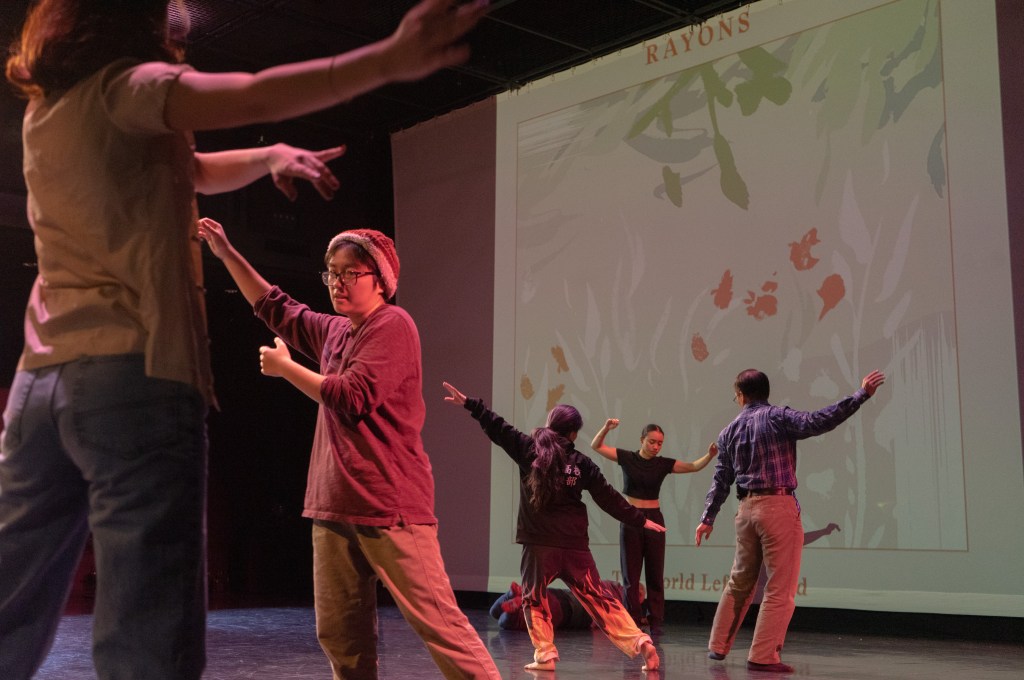
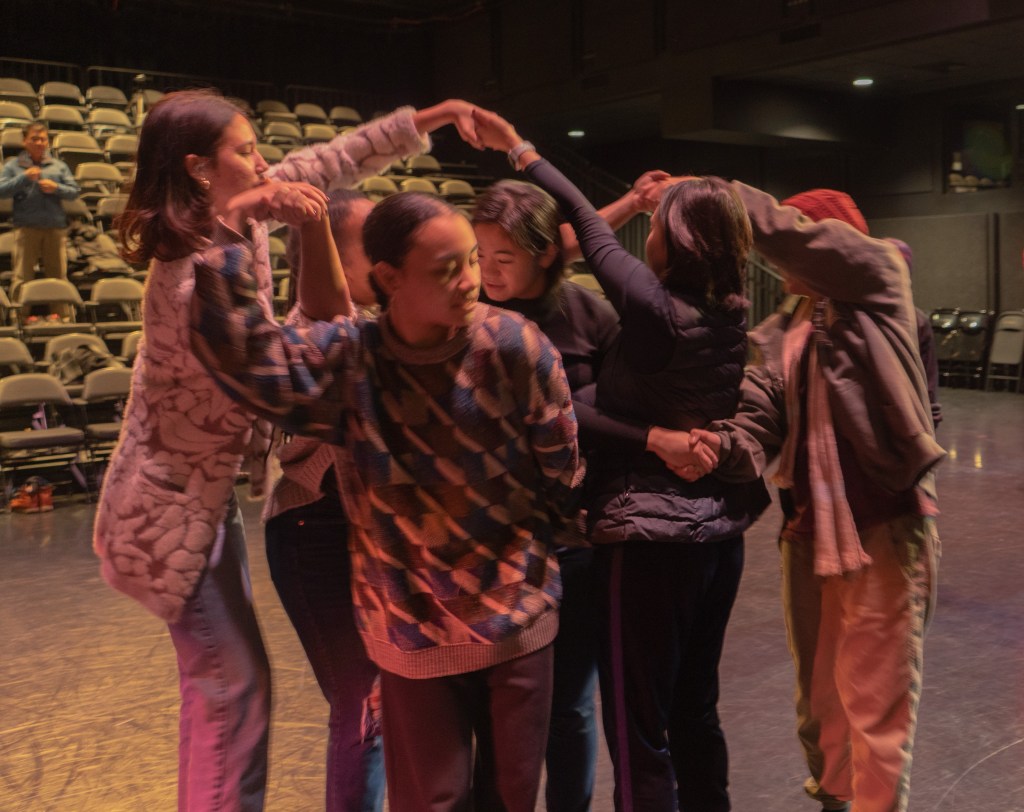
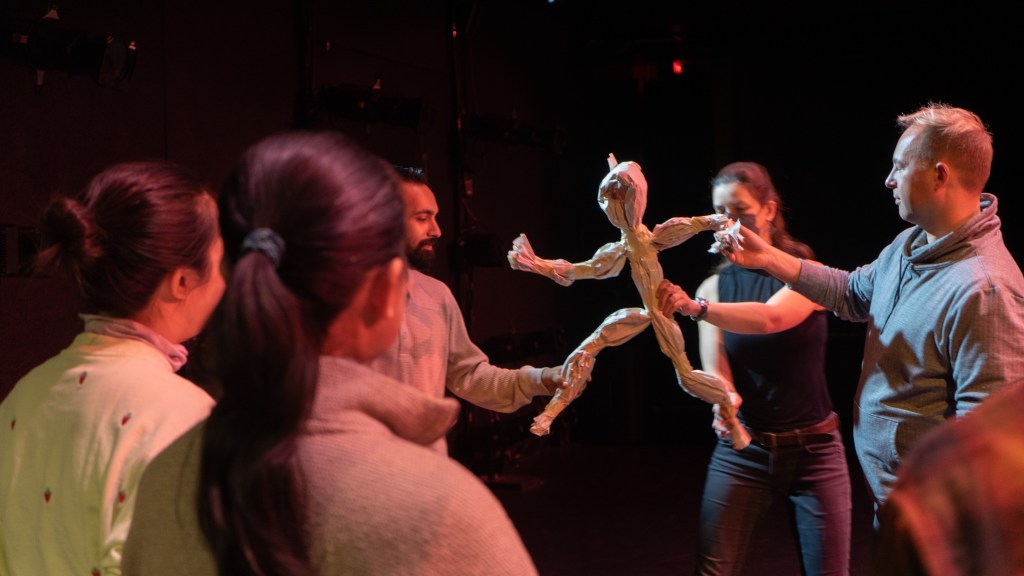
I organized the “Space Making Workshop” in November 2022 at the Ohio State University. Both artists traveled to Columbus for the first time on November 17th. The workshop was at the Barnett Theater from 3 to 5 PM. Nami started to make us move. She brings us to a circle and shifts weight from one leg to the other. Looking at each other, sensing each other’s weight. Naturally, we were smiling at each other. Nami incorporates puppetry in her work. She and I made the puppet on the site, and we offer participants to try puppetry. In Japanese puppetry, Bunraku is usually three puppeteer move one puppet. It’s coordination, communication, and storytelling. Next, following Ayako telling Japanese philosophy, Furyu (Wind and flow). Back to the circle, opened both arms, and breathe together. Found a partner and slowly improvised with music.
After all the movement sessions, we formed the circle at the Barnett Theater. I asked them prior to the workshop, What events/What things/who did shape them. It was so interesting to hear about their upbringing; what was important and affected them being who they are. As I write above, I felt my cultural identity always come forward more than myself. I was always grappling with authenticity and cultural representation. What does it mean to be an “Asian”, “East Asian”, or “Japanese” woman? I was curious to hear about their journey to think about the intersection between cultural identity and dance-making. Ayako is externally expressive about her choreographic inspiration which is based on the Japanese philosophy, Furyu while Nami doesn’t mention “Japanese culture” in her work. However, the way Nami communicated with dancers and how she utilized the space between dancers and movement phrases are informed by her college time in Ehime, Japan. No matter how much explicit their Japanese upbringing, both said “I am proudly being a Japanese woman making a dance work in the United States.”
During these intense two days, I spent a wonderful time sharing my and their story of struggles and successes. Moved and shared the space. Even though we were born and raised in different times and places, this workshop made a space for us to gather here, in Columbus, Ohio. Currently, we were working on a solo collaboration that I am going to share at the MFA thesis project showing on February 16th-18th 2023. Each artist oversees my work and creates the solo together with me over zoom and in-person studio rehearsal. I am excited to share our work at the end of my journey in the MFA program at Ohio State University.
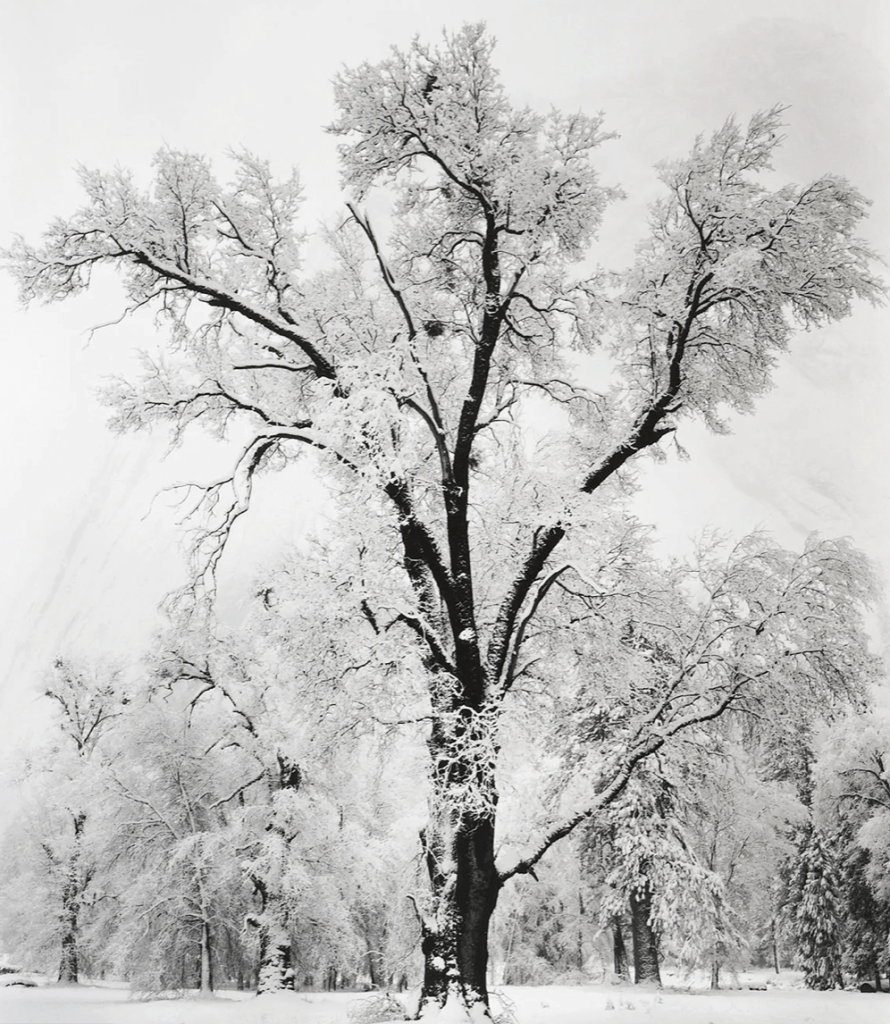
I am always fascinated by black and white photography. The simplicity of color yet provokes the imagination of what scenery looks and feels. I cannot deny my mother’s influence. In our living room, wherever we move to, she always hangs two black and white photographs on the wall. I am always fascinated by black and white photography. The simplicity of color yet provokes the imagination of what scenery looks and feels. I cannot deny my mother’s influence. In our living room, wherever we move to, she always hangs two black and white photographs on the wall. These photographs are taken by Ansel Adams. Very detailed, slow-shatter speed, high contrast photographs show the beauty of nature.
Oak Tree in Snow
Moonrise, Hernandez
In our world lives in, we prioritize speed. How quickly we can get to the goal, or achieve the results, find the fastest way to be successful… This semester, one of my favorite courses I am taking is the Darkroom photography course. The process of developing film photography in the darkroom teaches me howslow and delicate the process will assist in making the best result.
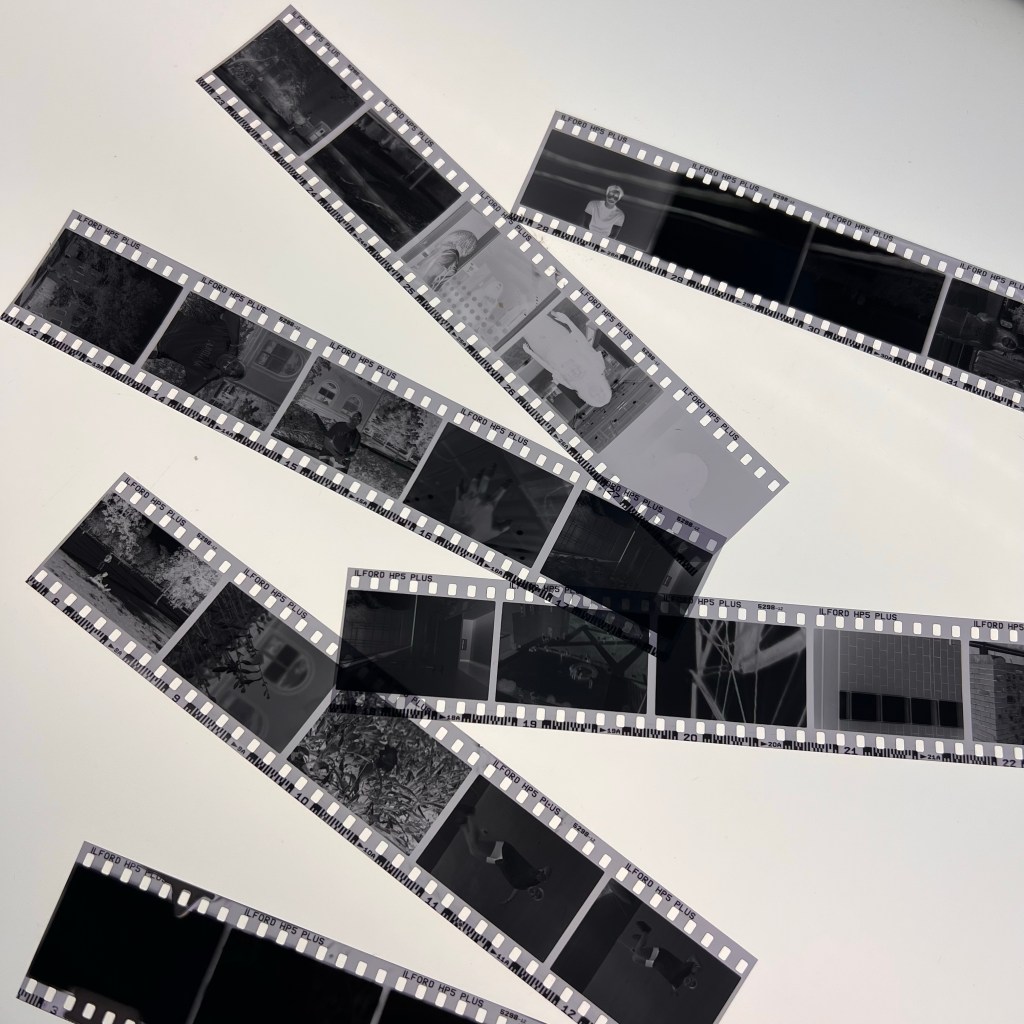
To see what you take in a film camera, start with developing the film roll to the negatives. Usually, the process takes 20-30 minutes. It required constant agitating with chemicals, almost like soothing the baby. The delicateness and slow porcess make a magic. There is one time, when I tried to develop the negatives by class time, I rushed the process and destroyed them… If negatives don’t develop well, all data turned out all black and will not restore the image. Also, it is impossible to recreate the moment you snap a photo. It gives you not only the sallow but the sense of loss. Same as human memories. We forget and lose someone, something, or some events in our life if we do not imprint them in our brains or recall them. These memories will vanish in the dark.
Correctly developed negatives
My damaged negative… so sad
After finishing making negatives, it’s time to make the prints. In the darkroom, use an enlarger to light up one negative on a printing paper. It requires experimenting with the duration of exposure time to get the preferred tone of color. The longer exposure to the light, the darker the color gets. Similar to human skin. After lighting up the negative on the paper, the print goes through 3 chemicals; developers, stop-bath, and fix. Sink it in each chemical tray for a couple of minutes with constant agitation. Finally, after all the processes, you are out of the darkroom and able to see the result.
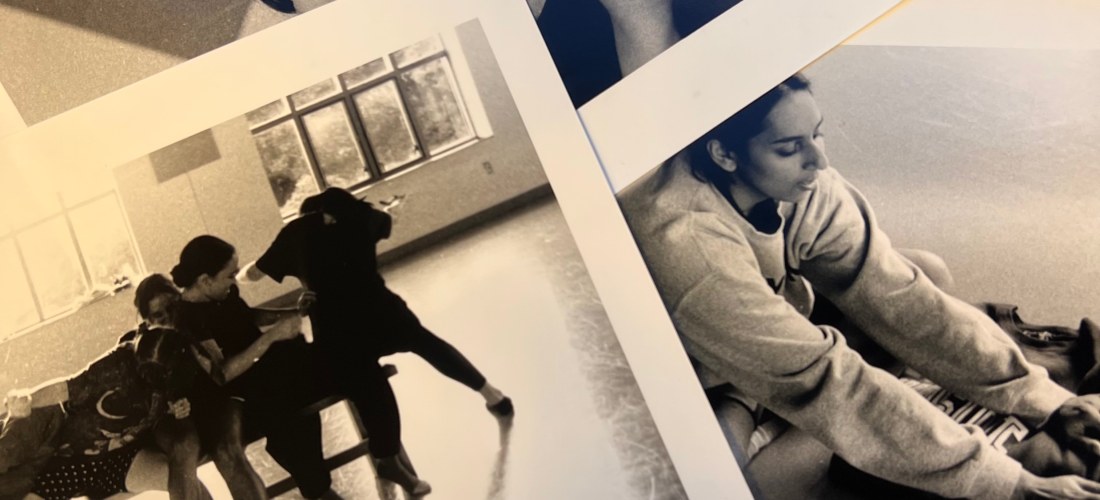
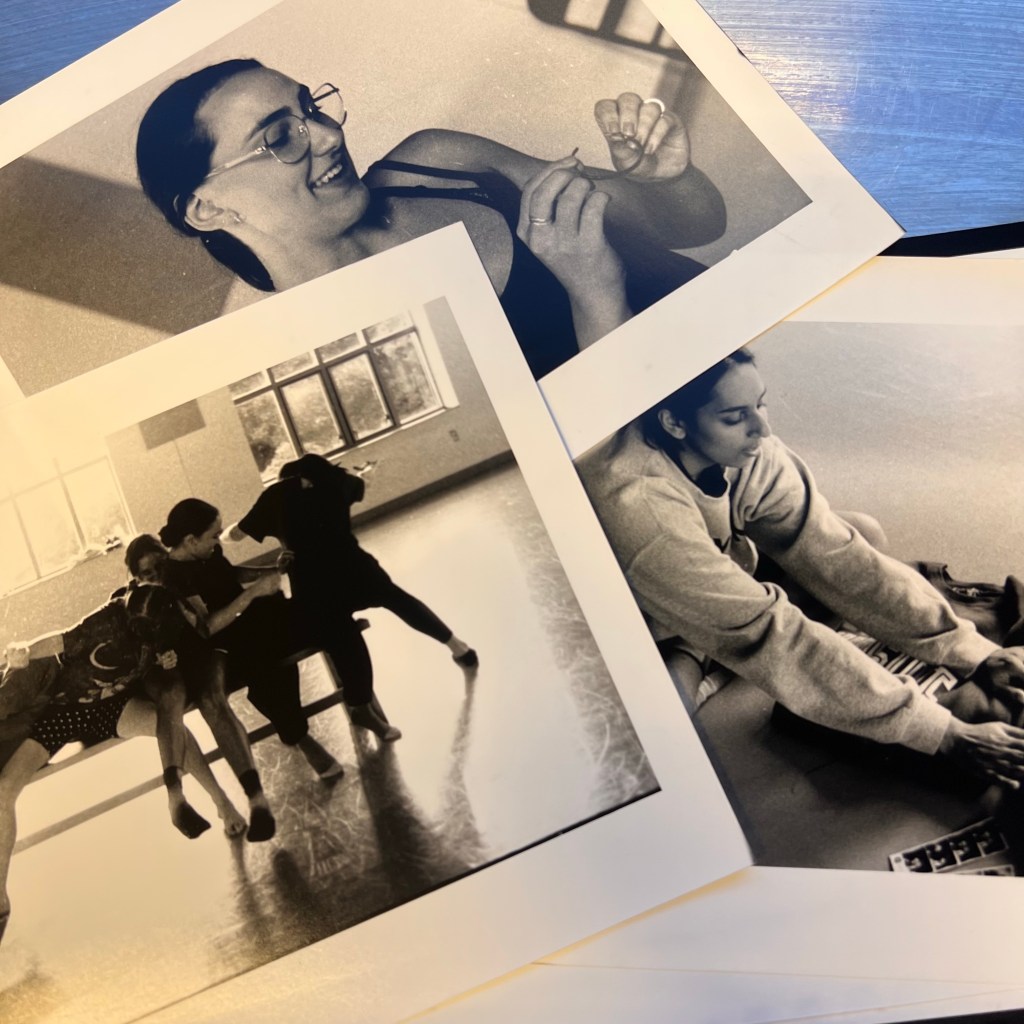
Rehearsal process on film photography
The pictures above are the moments from my rehearsal. I documented when dancers talked about their stories about their memorable objects. Looking at the prints, no matter how much movement inside the frame, they exist at the exact moment when I snap the camera. It’s almost like the camera froze the time. The sense of time is totally different in film photography compared to photos on the digital camera or on the phone. I see this difference as the magic of being analog. This analog technology makes time tangible. It is interesting how humans create film photography to capture the fragment of time. We have a desire to conserve the time slipping through us. And for me, using analog technology such as film photography gives me an opportunity to re-think the definition of time and understand the meaning of documentation. Going through all the processes with many hours to print one frame of negative is more meaningful than an instant snap by the phone.
I have been searching for who I am as an artist. And getting into the beginning stage of my thesis, I pondered the experience of being a Japanese female contemporary artist in the United States. I have my own unique experience of how did I arrive at this point in my life. However, I was curious to hear the story of precedents.
Over this spring semester, I have researched one Japanese female contemporary artist, Saeko Ichinohe. Saeko Ichinohe came to the U.S. in 1968 and since then she performed/choreographed/taught dance as a cultural exchange experience. She was inspired by Japanese culture, philosophy, poems, and literature. She was well-known for bridging Western concert dance and Nihon Buyoh (Japanese traditional dance). She passed away in 2021 though I was fortunate to access her choreography through Labanotation. I chose “Chidori” because she notated the choreography by herself in 1972. I wanted to know her movement pattern through how she notates.
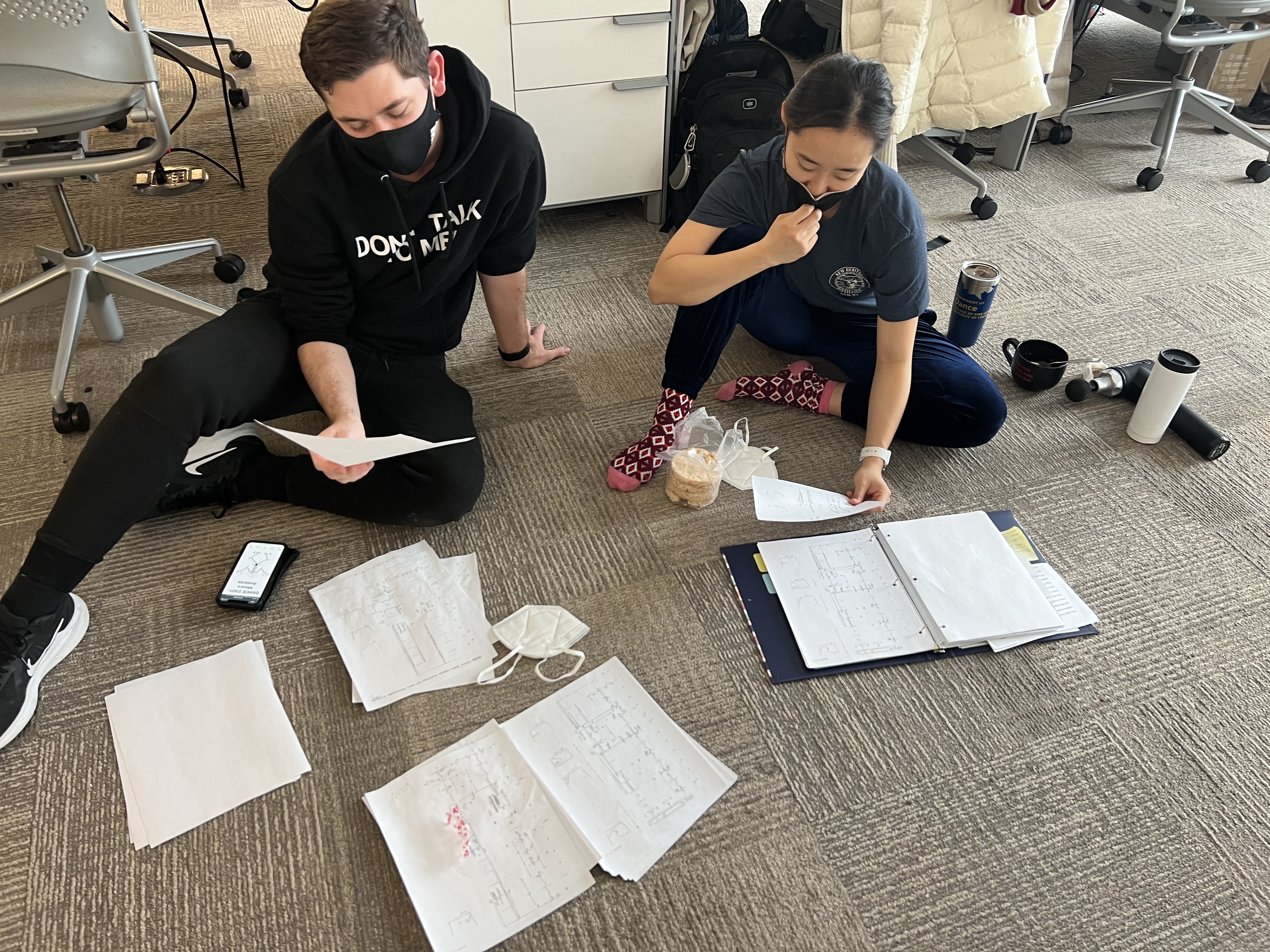
I asked for help with reading scores from Dr. Williams and my cohort, Forrest Hershey. We met two times a week to read and move our bodies to connect with Ms.Ichinohe kinesthetically. She emphasized the location and direction of the weight. Weight drives the movement the most and clearly draws the space between two dancers. “Chidori” is a love story between a fisherman and a bird, so I imagined that she has a specific instruction to deliver this story.
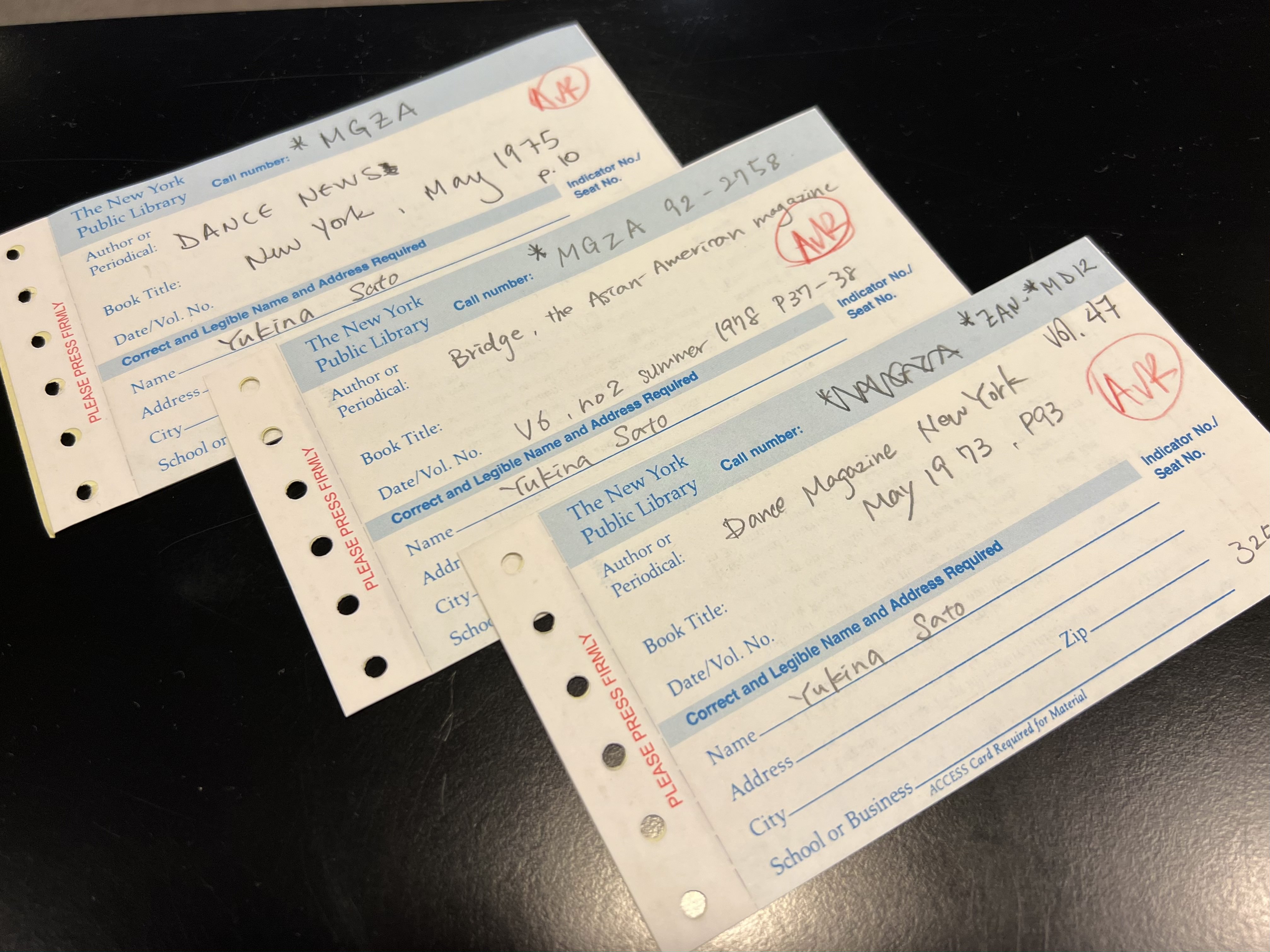
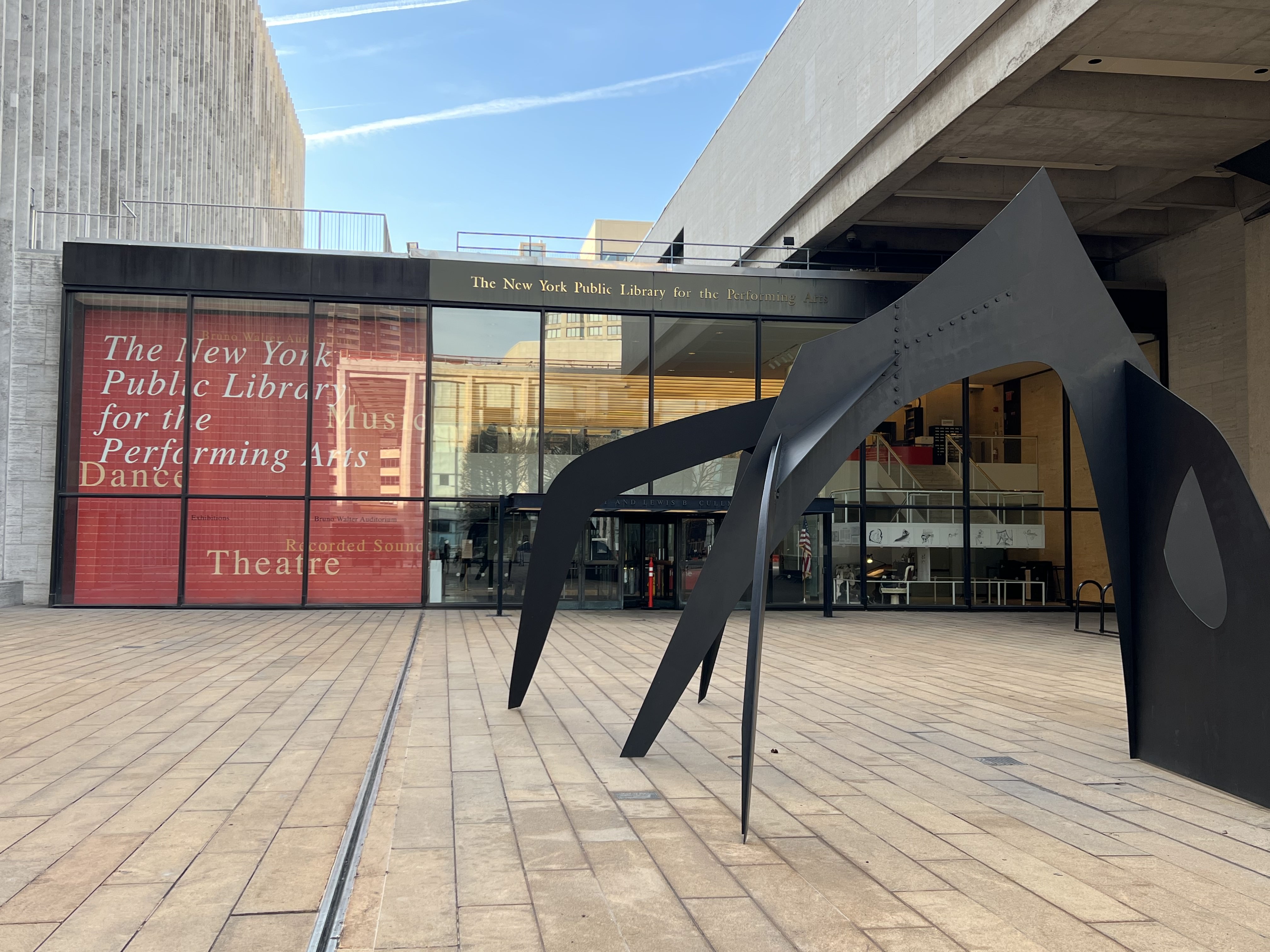
I wanted to know more about her artistic journey outside of notation score. I have researched her online yet there were only a few materials available. Then I found out that there are a couple of her personal archives are stored at New York Public Library. So, I decided to go to New York City in March to trace her footsteps. At the library, I watched many video recordings and read her artistic statements, CV, company record, and choreography notes. All the materials help me to understand her deeper than it used to be. Also, I visited all the locations she filed as her company locations and performance venues. Even though our paths did not cross, through her archives I could know her and her passion deeply. Sharing the same space where she practiced, performed, and choreographed was meaningful to me. I summarize my research journey on Saeko Ichinohe in a short documentary film.
Tracing her footsteps made me think about how I want to proceed with my career as a contemporary performing artist. Ms.Ichinohe made the most of her Japanese upbringing and integrated it with her primary dance training; ballet, and modern dance. I have a similar background in former movement practice as her. Although, I have a huge resistance to being perceived to be unique because of my cultural heritage. I was born and raised in Tokyo, Japan where I can encounter many people visit from around the world. And since I came to the United States in 2016, I have absorbed multiple cultures into my body. However, I cannot get rid of the labels such as “female”, “East Asian,” and “Japanese” from my body. When I stand on the stage my body speaks out louder than who I am. Therefore, dancing serves me how to free myself from the labels. How I can challenge my audience to see my authenticity that is coded in the movements that I create. This question was the start of my solo practice.
The research journey concluded on 4/16 performance “Transcendence -時を超えて-” with amazing collaborators, Columbus Koto Ensemble/ Forrest Hershey/ Yujie Chen. I also have huge thanks to Dr. Williams, the Institute of Japanese Studies, and the Center for Ethnic Studies to make this performance happen.
Time flies so fast. I started the 2nd year of my MFA program. It’s been like a jet coaster ride: running around, ups and downs with full speed.
There are many ”new” things happening this fall semester. 1) I am teaching two movement classes jazz and ballet for non-major students, 2) fully in-person classes, 3) living with one of my cohorts…. so many ”first time”!! It is exciting but exhausting at the same time.
My challenge for this semester is to ground myself and preparing for the fruits of this MFA journey. The starting of my 2nd year feels fresh like my 1st year since we are shifting to fully in-person class. COVID is still a thing however I definitely have a strong community that I can rely on and deeper creative thoughts.
In Japan, there is a quote from Zeami,
“初心忘るべからず。=Don’t forget your first resolution.Always keep your mind open and evolvIng.”
Zeami established Noh, which is the oldest traditional performing arts in Japan. He mentioned in his book saying obtain one art form takes a lifetime. As a movement practitioner, this word hits me hard. It tells me the importance of rooting myself and reminding where and why I started this journey with dance.
My hope this semester is to deepen my understanding of the relationship between me and dance. I have been dancing for almost 22 years yet there are many things I need to learn to expand. However, if I keep looking up and forget the root, I will lose my growth and eventually fall.
Reminder: Pause and look down where you arrive at. Finding the connection to the ground and feel the root/the heart where everything starts from.
This semester, the class I was really excited to take was Intermedia Lab with Professor Norah Zuniga-Shaw. Due to the COVID restriction, we could not get inside of the Motion Lab, which I was disappointed with. Although I was so amazed by all the resources from viewing, reading, discussions, live events that she brought to the classes, the technology lab with Oded, and classmates who are bold to try new ideas, open to collaborating, and dive into the creative journey of unique, evoking, mesmerizing projects.
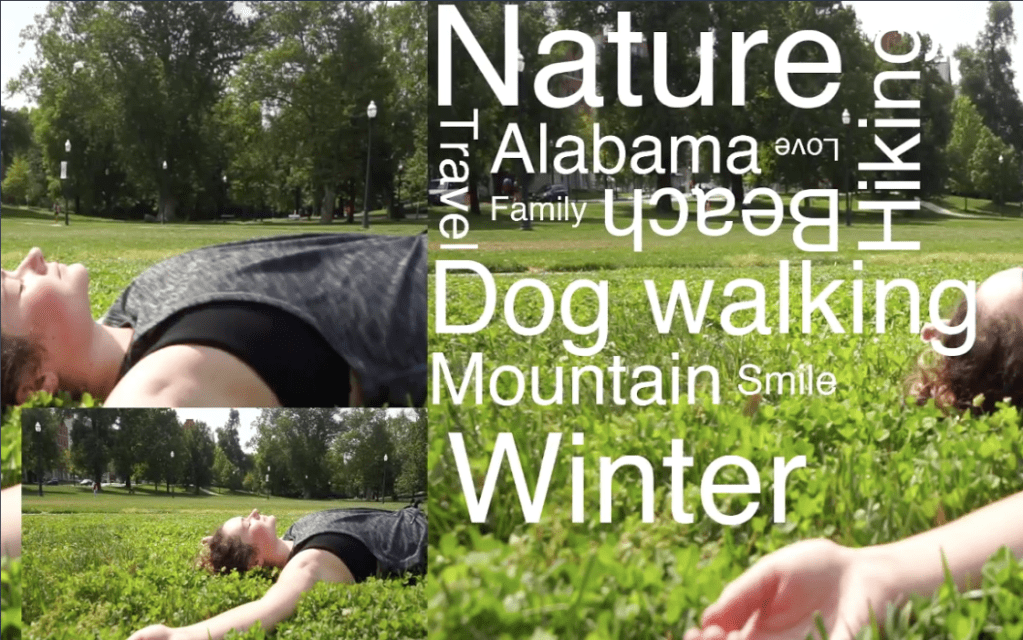
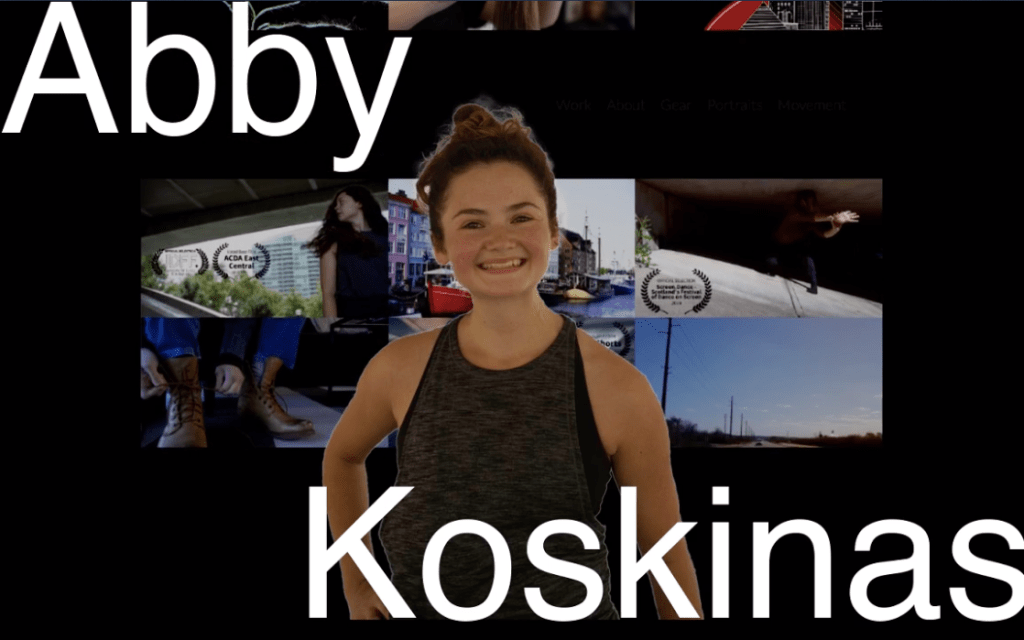
The first project I did was a “digital double” project with Abby Koskinas. She was a senior year BFA student in dance at Ohio State University. I build her doubles by interviewing her and ended up portraiting her rigidness for creativity, but spontaneous and adventurous personality. We streamed through OBS, a design and streaming application. Learning OBS was also a new way of creative thinking because I was used to horizontal timeline designing instead of vertically layered scenes with text, video clips, and audio. It was challenging, yet worth spending time and fighting to reach the level of I satisfied.
The most interesting idea that I learned over this class is creating sonic space.Hearing is such a strong sense to bring the sensation and connect to the memories or experiences directly. At the beginning of the semester, I tend to listen to songs written in Japanese. And realized that I was trying to make a safe space sonically. So from my experience, I was curious in creating an intimate place for an artist to share with the audience. Then throughout the corse, we had Voicemail “Pen Pals” Choreography for the Ears and Audio Walk at the South Oval in person which all inspired me. Another reference is Taryn Simon’s Assembled Audience. I visited the exhibition at the Wexner Center for the Arts at the beginning of October (The link below). It was an eye-opening experience! The darkness sharpens the hearing and the sound of crapping gives me the sensation of being surrounded by clouds of people.
My interest leads up to the second project, Surveillant Hall Audio Memory Walk. I partnered up with Abby Koskinas again to collect the memories of the Surveillant Hall from most of my classmates. I have always wanted to know what the dance building used to be before the COVID-19 hits so this project was like a treat for me. We started from the entrance and decided to navigate the audience by introducing each space from the 1st floor to the 3rd floor. Abby did an amazing job to contact other undergraduates to collect their stories. We actually went inside the building and calculated the time in between moving each studio, walking the aisle, and going up and down the stairs. It took a long time to put together all the audio files, although it was a really fun process. We wanted to corporate the video clips as well, though time was limited, and hard to obtain some clips from the Dance department.
Surveillant Hall Audio Memory Walk was the prototype of my final project. It is dedicated to the specific location and the memories attached to. I used the same structure but changed into my home town, Tokyo Japan. Started with brainstorming how I navigate the audience and decided to make an audio trip, “Safe and sound”. I came up with an idea while I was flying to Detroit, so I had a clear image to imitate the airline announcement. Then I started writing about my daily life in Tokyo adding my personal memories, waking up in my house, walking to the train stations, going to the school, getting snacks on the way home, and coming back to the house. I spent a long time researching online to find the exact sound that I wanted to use. After I have a solid collection of sounds, I put them all together on GarageBand. I did not have time to dive into learning Audacity so that’s the only thing I would like to go back and spend time more. My goal is to create an immersive, intimate, vulnerable experience to share with the audience.
Overall, I am very grateful for this class to open my eyes to technology and introduce me to new perspectives to present the artwork. This class pushed, motivated, and encouraged me to start with an idea to create even though you don’t know the direction you want to go. The maker should let making lead the way. That what I learned the most in this class. I will continue to be bold and say YES to the ideas and keep creating.
Over the quarantine, I have started teaching Japanese online. And it was so interesting that while I am teaching the language, I relearned how to speak my mother tongue and realized the significance of the language. This experience inspired me to corporate my mother tongue and dance.
So I have a concept in my mind that “what if the dancers heard their own story in a foreign language, what movement comes out?.” It was on Friday, after the Choreography Workshop, walking the aisle with John Cartwright, Ishmael Konney, and Quianna Simpson. I asked them if they were interested in working with my concept. Fortunately, they said YES! So we started meeting on Thursday afternoon to rehearse.
At first, I asked all of them to write a paragraph of their self-introduction. I translated the texts into Japanese and recorded them. Dancers danced with their own biography, which they could guess what I was talking about, yet it was hard for them to fully understand. Quianna shared that she recognized some words such as”African dance” but she was influenced mostly by the rhythm of speaking. Also, John mentioned that it was dancing in between familiar from and unfamiliar. Next step, I asked them to dance with other’s bio which they have no clue what I was talking about. Ishmael shared that he was inspired by the speed of my speaking and almost echoing with his body. Dancers were definitely hard to react to speaking voice with unknown topics since no connection nor inspiration to their movement. What they react was the sound, rhythm, tone, speed I made. It was a great discovery to me since I was seeking an authentic reaction from dancers to the foreign language.
So we ended up using their biography with my speaking to generate the basic phrase. In the first version of this project, I was a narrator and started speaking Quianna’s story, then John’s and Ishmael’s at the end. The person who was spoken one’s bio leads the movement and others echoing. It was a clear structure of displaying how dancers embody the sound of Japanese.
Although, we received feedback about I and dancers’ relationship as well as an objective of this project. We discussed one more time to clarified the intention of this project and landed on offering a foreign experience to the audience but also showing the visceral level of communication. Also, we decided to not separating me from their narrative. I added on my story to move together as well as bringing back idea, authentic reaction; dancers react to what I spoke without knowing the content. We revised the movements, and space usage as well.
Over this process, we re-defined the fundamental of communication by using verbal and non-verbal tools able to understand, interact, respond to each other. Once Quianna shared that we seemed like creating harmony by bodies, which was a beautiful way to describe our creative journey and indeed it was a deep and interesting process. I would like to continue experimenting to combine my mother tongue in my work.
In Dance Film 1, Professor Mitchell Rose said “there is nothing new in this world.” I was shocked! But it is so true that something human has been expressing either by films or music or dance is the same theme over and over again. We as humans are facing the same theme of life, but experience it in our own way. Also, he said, “but there is only you in this world” which means I can have the original viewpoint which no one can have. This encourages me to find uniqueness within me instead of looking outside and comparing what I am lacking. Since the beginning of this semester, I have been thinking about what I can bring to the dance community at Ohio State University. So, my interest is I would like to comprehend my artistry deeper and it is evolved into my first research topic, understanding self-identity.
I am hoping to learn self-identity by investigating Japanese heritage and the life experiences that I earned through the travels. First, I would like to reveal the relationship between dance and Japanese culture by seeking the answers to so many questions that I have not solved yet. Such as how Japanese people embody their culture through dancing, what movement is defined as “Japanese-ness,” and what makes me push to study contemporary dance abroad. Also, I am very curious about foreign experiences in the body, locations, relationships, and lifespan and what makes people decide to stay or leave from there. Foreign experience is always part of me where I go and I have been wanting to unpack my emotion and thoughts through migration from Japan to the U.S. And I am focusing on Issei, who born in Japan and immigrated to different countries, performing artists specifically. It is because one, I might be a possibility to become one of them, but two, it would be great to bring objectivity in my research. I would like to investigate the artists’ hybridity of cultural identity as in how they have been creating their “home” at the new place, people, culture while keeping their roots, customs, and tradition at the same time.
The second is the nature of communication. I have noticed that word selection is very sensitive especially in an academic setting. Verbalizing is a huge influence on creating meaning, culture, mannerism. Even though dance is called non-verbal communication, it has different movement vocabularies in different dance genres. Over the quarantine, I started tutoring Japanese to kids to the graduate students. And I have noticed the similarities between teaching language and teaching dance. In dance class, everyone brings a different language through their bodies. It is like everybody speaks a different language. So, I am interested in how I as a teacher can strip off the specificity of terminology and able to communicate on a visceral level. My goal is generating a way to hybrid the cultures brought by everyone in the classroom and to create one dance language to speak as a whole class. In order to reach this goal, I would like to synchronize my study in Japanese (as language) and dance pedagogy. By establishing the common dance language will help to unite the people beyond the borders in the future education setting.
I am still on the stage of brainstorming yet, getting clear each day. I am very excited to work on my research project! Please let me know if you know about the resources related to the research topics on comment below. I appreciated any comments, suggestions, and ideas:) Thank you!

















 Yukina Sato